Showing posts with label landscape. Show all posts

Friday, May 3, 2024

Over the sea to Skye

A week ago, had someone asked me if I had ever visited the Isle of Skye, I would have probably said, "I don't think so". In a more adamant mood, I might simply have said "No". I would have been wrong.

Leaving aside the questionable use of photo editors and artificial intelligence, actual photographs don't lie. So, while revisiting some of my Kodak slides from the early 1970s, I came across some pictures that caused me to wonder, 'Where was that taken?'

Where was that taken?

Fortunately, there is Google. A reverse image search told me that this was a view of Uig on the Isle of Sky. Really? Sure enough, a bit of playing around with Google Street View, allowed me to see Uig from close to the spot I must have stood to take the photo:

Google Street View looking over Uig

There have been changes in the last 50 years: The wharf at Uig has been extended, grass no longer grows in the middle of the road, and barriers have been erected to protect the careless.

The revelation of a Skye visit also made sense of some other photos, like a picture of churning water, taken from a boat - the Skye ferry (before the current Skye bridge was built) and the view from Duntulm Castle (apparently now fenced off from the public).

View from Duntulm Castle

Many photographers travel the globe looking for unusual places to photograph. Of course, that inevitably leads to others following in their footsteps and the uniqueness of those photographs soon fades. 

I'm just back from a virtual visit to Skye in the 1970s. The 1970s was pre-internet, pre-Instagram, pre the explosion of digital photography. If you want a picture of Uig without Armco barriers or the view from a now-inaccessible castle, then I'm sorry; you're a bit late. Isn't time travel wonderful? 

I like the 1970s, "Over the bridge to Skye" just doesn't have the same ring to it.

Friday, May 16, 2014

One simple trick

Last weekend I was taking some photographs at the observatory on top of Mt. John. I don’t normally watch other photographers but it was hard not to in such a popular scenic spot. Over the course of a couple of hours I became aware of one repeated behaviour: get out of car, walk to the edge of the car park, hold camera in front of face, take picture.

I saw no exceptions to this behaviour. It didn’t matter whether the camera was a cell phone, a compact or a big DSLR; one photographer even set up his tripod at the edge of the car park, adjusted it to face height and took his picture. I wish I had the foresight to take such a picture, so that you could see what it would include, but that only occurred to me later after I had left. Magnificent vista that it was, their pictures would have included a mountainous background with a valley lake in the middleground and NO FOREGROUND.

As humans, we experience all such views from the foreground - even if our focus is on the distance. The foreground is where we stand, it fills our peripheral vision and provides context for the rest of the scene. When you see a picture without a foreground, it doesn’t capture the experience of actually being there, and we end up feeling disappointed that the picture doesn’t reflect the moment. Unfortunately cameras don’t have peripheral vision – what’s in the viewfinder is all you get so you, the photographer, need to introduce some foreground into the scene.

Ten paces away from the car park edge there is an interesting rock. Down on one knee, rock in the frame and the picture has what it needs – foreground context, strong middle ground, and magnificent background. It’s that easy.

So that’s my one tip for your vacation landscapes; don’t just do what everyone else does by standing there and clicking into the distance – just change your position, bend a little if you have to, and include some foreground interest in the scene. That’s not a rule by the way – not every picture has to have foreground - but most landscapes will benefit from its inclusion.

Thursday, June 7, 2012

Life on a snowball

After yesterday's large dump of snow, we awoke to a fine morning with the moon handing over lighting duty to the sun.

Venturing outside we found ourselves living on a giant snowball:

In a world that looked almost infra-red (at least to the camera):

I do love how snow makes even the familiar and mundane things look strangely alien.

Of course, few people seem to be working around here today as the roads are barely passable; that seems to have made the majority of people smile though there are a few 'grumpy's' around. Me, I'm a smilin'.

Thursday, May 31, 2012

Don't delete - ever

Digital photographs are easy to accumulate in vast numbers. Some photographers recommend deleting anything that isn't perfect - as soon as possible, preferably before it leaves the camera. I don't subscribe to that philosophy and keep everything I shoot unless its absolutely awful.

I have a folder structure that allows good stuff to 'bubble' to the surface while all the raw material (usually RAW material) sits in a series of basement folders called 'Originals'. When I need to try out some new software or attempt a new processing approach I dig into my 'Originals' folders to find something to practice on. Case in point is the picture below - what I wanted to try didn't work out but, in the process, I discovered the original reason I took the shot - the light - buried beneath a rather dull and uninteresting set of RAW files.

"Evening light - Canterbury High Country" - camera Nikon D80, 28mm, ISO100, 1/15sec, f11 (9 frames)

So, tonight I feel vindicated and confirmed in my old hoarder ways :-)

Sunday, May 6, 2012

Up-size me, please


Today, I have been playing around with some old reject images as test subjects. My issue was, 'how to print at large sizes (say 1m wide) when you only have a camera with a 10Mega-pixel sensor? To print with good quality at 1m width would requires an image about 50Mp in size - larger than the new Nikon D800 and well into the outrageously expensive medium format digital category. However, Mp is a square measure and, while the long edge of my 10Mp sensor is 3,872px, a 50Mp sensor would be about 8,640px - only a 2.2x linear increase.

Conventional wisdom (and my own prior experience) says that you can't increase an image by 220% and get good quality (even using professional re-sizing tools)  but today I tried some other techniques and came up with a solution that provides good sharpness and smooth detail without obvious artifacting. Even with my perfectionist, pixel peeping, ways I would be hard pressed to detect the up-sizing, if I didn't know. Basically, after cleaning the image of any digital noise, a standard "bicubic smoother" upsize, followed by a pass through Topaz 'In focus' and a light touch with Topaz 'Detail', provides a large image file that I am happy to work with.

Of course this web picture is not 1m wide, so you can't see the results, but if you are a Topaz user you can try for yourself and see what results you get. This is not something to be applied at the end of the processing - it is something to do at the start, so that you have a large digital file entering the normal post-processing cycle. done this way, you can still provide some additional output sharpening using whatever tool you prefer at the end.

Anyway, re-sizing aside, this image had quite grown on me by the time I had finished. :-)

Friday, January 27, 2012

Moeraki Boulders

A monochrome picture of the boulders at Moeraki.
Nikon D80, 8mm fisheye, ISO 200, 1/250 sec at f11.
A full-sized version of this picture is also available for sale as a print or greeting card at: http://www.redbubble.com/people/phoxford/works/8392596-moeraki-boulders

Wednesday, January 25, 2012

Boulders and Penguins

Fresh back from the North Otago coast, as promissed we have boulders and penguins. The boulders are the "Moeraki Boulders" - see the Wikepedia article at http://en.wikipedia.org/wiki/Moeraki_Boulders. Unfortunately, we had cloudy dawns while we were there so never got the best light to photograph them.

The penguins were the "Yellow-eyed penguins" (http://en.wikipedia.org/wiki/Yellow-eyed_Penguin). Usually a timid bird, this adult and juvenile seemed quite content to watch me photograph them over several minutes. The nest was on the top of a high cliff with a very nasty climb down to the beach below - I am not sure how flightless birds manage that!

Thursday, January 12, 2012

Fish out of water

It's so hard to resist the 'fish' puns but I will try to cut back. Anyway, first real outing with the fisheye today, in one of my favourite haunts - the Port of Lyttelton. I am liking the way that one can create these lovely curved 'leading lines' with the fisheye. In this shot the camera was pointing downward leading to a significantly bowed horizon line. A similar shot from the same place but with the camera leveled seemed to loose much of the dynamism created by the curved lines.
Nikon D80, 8mm fisheye, f11, 1/125, three exposures, tinted black and white.

Monday, January 9, 2012

Observations on the fish


If I thought that using a fisheye lens was simply a case of, “it’s just another lens,” then I was mistaken. There are, it seems, new compositional factors to discover and learn and there are technical challenges to address. The compositional aspects I am still working through, but one technical aspect is that, in an outdoor environment, almost every shot will have a high dynamic range and will need to be treated with whatever technique you use for HDR.
The reason for the high dynamic range is the field of view; it is so large that the chances of including both very bright and very dark parts in the subject are greatly increased – even compared to something like a 10mm rectilinear lens. To combat this, I have found that +2/-2 bracketed shooting is the new ‘normal’ for the fisheye and that in some cases I need to bracket out to +4/-4 or further, to cover the range.
The following shot of our school observatory was taken on a cloudy/bright day, facing away from the sun and required a +2/-2 treatment. With other shots taken towards the cloud covered sun, +2/-2 was not enough and the sky was badly burnt out.

Nikon D80, with Samyang 8mm fisheye, f11 (3 exposures).

Friday, January 6, 2012

Gone fishin'


Yesterday, my long awaited fisheye lens arrived so I strapped it on and went out to the yard. The family car proved that not all subjects are well suited to a fisheye – unless amusement is your aim!


But the front wheel of the kick-bike showed that some subjects can be kept in shape while the rest of the world is bending crazily.
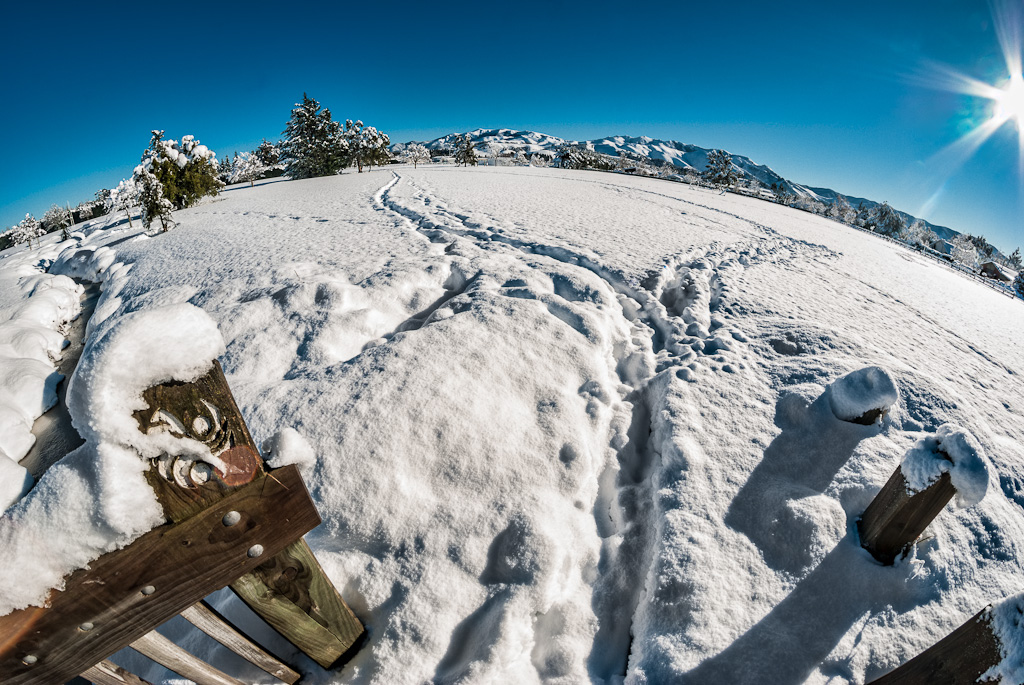
A walk down the road to the cricket oval quickly demonstrated the wonderful new perspective that a fisheye can bring to a landscape. It also demonstrated how the sun can quickly lead to burnt out highlights – this shot would have benefited from a wider, bracketed, exposure.

OK, there’s nothing ‘artsy’ here yet, just some demo shots to show what the lens can do - the lens in question being the Korean Samyang 8mm fisheye. It’s rebadged by a number of companies and mine came dressed in “Bower” clothing, though I believe it’s often seen as a “Rokinon” or a “Vivitar” and probably a few other names as well.  In the USA these sell for well under $300 dollars so, even after importation costs, it is still a third of the cost of a ‘name’ brand fisheye lens.

Part of the low cost is the fact that it is a manual focus and f stop lens – no autofocus and no auto exposure. But with a fisheye these are less of an issue than you might think. Stopped down to f8 the depth of field is so impressive that I just set it to 3m and left it there. And exposure calculations took me back to the days before I even owned a light meter – just look at the sky and guess that today is (for example) an f11 at 1/125 sec day. Even from my first outing I had less exposure errors with this lens than I usually get with the TTL metering – all due to the huge field of view where its averages, not spot metering that count.

But is it sharp? Yes, it’s sharp even at the edges from about f5.6 onwards. At f3.5 there is some softness at the periphery, but no more than I have seen with some zoom lenses. For a fisheye the sharpness is very impressive. If you are looking at a fisheye lens then I can highly recommend this one available at: http://www.bhphotovideo.com/c/product/635177-REG/Bower_SLY358N_SLY_358N_8mm_f_3_5.html  or at: http://www.amazon.com/Rokinon-FE8M-N-Fisheye-Nikon-Black/dp/B002LTWDSK/ref=sr_1_1?s=photo&ie=UTF8&qid=1325835494&sr=1-1

Sunday, December 11, 2011

Another one from the archives ...

This one was a real challenge; It was about the sky - a deep blue Canterbury spring sky. But, whenever I pushed the saturation and luminescence sliders to get the depth of blue I wanted, all I got was horrific posterisation (banding) in the sky - even editing at 16 bits. Eventually I decided on a masked multiply layer rather than pushing the individual colour values and this had the desired effect without any banding artifacts. Another lesson learned.

Eyre River, near Oxford, looking towards the Alps. Two frame stitched panorama, 50mm, 1/160, f11.

Friday, December 9, 2011

Two years later ...

It's amazing the difference two years experience can make. I took this image in 2009 but it has languished on  the hard drive for two years because I couldn't get it looking right. The main problem was noise. there were huge areas of noise in the mid-ground trees and even to reduce the noise to that level, there was excessive smearing of the distant details. In short it looked a mess.

Since then I have acquired better tools (Topaz) and a better understanding of how to use them. Installing Lightroom 3 this week, the original image resurfaced and so I took another shot at it using the new tools and a more refined workflow:

Now it looks the way I originally wanted it to; no visible noise and nice sharp detail all the way from the foreground rock to the mountains - 14mm, 1/350, f16, IS0800 (hence the noise problem).

Friday, November 25, 2011

Container City

Yesterday we went to 'Container City' the new and emerging heart of wounded Christchurch. Visited the Apple Store, Johnson's the Grocer and Scorpio Books - all buzzing with lunchtime activity. It's so good to see the Central City begin to show signs of life again. Who knew that containers could look so good?
 More pictures at: https://picasaweb.google.com/102496606900301125582/ContainerCity#

Wednesday, November 23, 2011

Glentui Bush

Took a walk in Glentui Bush on Monday with the intention of refining my processes for High Dynamic Range photography in general and panoramic HDR in particular. This was the second trip as I totally messed up the process on Sunday and came back with only half decent material. The second time was much better and the process seems pretty solid now (if a little time consuming).

This shot is the compilation of a 3 frame x 6 exposure sequence (18 images) taken at ISO 100, f8 and speeds between 1/500 and 1/15 second. Each exposure sequence was combined in Photomatix Pro and the three images stitched in AutopanoPro. Further processing was done in Photoshop using Topaz filters.

More pictures from this outing can be seen at: https://picasaweb.google.com/102496606900301125582/SpringGlentuiBush

Friday, November 4, 2011

Don't play on the tracks!

I wasn't; I was walking along the maintenance walkway at the side of the track. Halfway to the centre of the bridge and back again. I had just stepped off the walkway when the freight train came along allowing me to get this picture:
The scary thing was how much of the walkway the freight train took up - I had thought I would be safe against the hand rail but, no way. Another photographic near miss :-(

Friday, October 28, 2011

A Bridge too far ...

The suspension bridge that crosses the Eyre River at Wolff's Road is a majestic though dilapidated structure with its ends buried deep in bush. Built in 1945 to carry foot traffic, it's span is about 80m give or take a bit. One can be excused for wondering why it was built; the river floods on only a few days a year and there are other crossings readily available by car. But, in 1945 the alternative crossings were either Oxford or Mandeville and, as The Press observed, the flooded river "kept children from school, farmers from stock, cream from porridge, and urgent supplies from the farms." Today, only the foolhardy would attempt to cross the broken structure, but it seems a shame if its only destiny is to become rotted wood and rusted steel.


Thursday, October 13, 2011

Rediscovering the opalotype

Photographic history is littered with now obsolete processing methods, like the cyanotype or the daguerreotype. One of the advantages of today's digital darkroom is being able to revisit some of these processes without needing to acquire specialist materials and chemicals and engage in strange rituals in darkened rooms. One such process that I am really enjoying is the opalotype.

Opalotypes were produced on milky white glass plates and the resulting monochrome image was then hand tinted to produce pictures that were (according to Wikipedia) "close to watercolour or even pastel in its softer coloring and tender mood." I suspect that it is probably this quality that draws me to the effect for certain subjects; like the Old Iron Bridge near Twizel in South Canterbury .

What do you think of the opalotype; nice and subtle or too last, last, century?

Wednesday, October 12, 2011

Mind bogglingly big

Last weekend we ventured far into the southern depths of Canterbury in search of some r&r. But we also wanted to see the hydro scheme and to visit Mt. Cook. This is MacKenzie country where, even in Spring, the grass is brown and the trees few. The 'brownness' of the MacKenzie is a bit disconcerting at first until you realise that the monotone simply draws attention to the broad sweep of the landscape.

This is HUGE country, where even a road seems little more than a temporary pencil mark on the land. The hills roll ever onward in their brownness eventually to be dwarfed by the towering peaks of the Southern Alps. It makes one feel small; not much bigger (nor significant) than the rabbits that seem to find it all to their liking.  But again, the bigness of the landscape points to another bigness: the bigness of what human beings have achieved in remoulding this landscape for the hydro scheme.

Of course there are the lakes, but they only require a dam to be built and filled with water. More amazing is the extent of the earthworks that have been necessary to reshape the land so that broad canals can gently carry water from one lake to the next. It's a big land which has been levelled and built up to suit man's needs, rather than natures whim. To stand there and ponder the amount of work necessary to sculpt a land in this way just makes the mind boggle.

Part of the canal running from Lake Ohau and, eventually, into Lake Benmore

Friday, October 7, 2011

Playing in the rain

The advantage of rainy days is that I can sit at my computer and play with new ideas and approaches to pictures, without feeling guilty (about the length of the grass, the weeds and the vegetable garden). Having upgraded Photoshop Elements to version 10 (from 8) and Topaz Black and White effects to version 1.1, I have had quite a lot to play with. This large format (100 cm width) picture was the result of a couple of days 'play':


Originally taken with a 10mm lens on a Nikon D80, it is now a 7,800 x 5,400 pixel image file on a canvas texture, as shown in this 100% crop from one edge:

I have been hugely impressed with the Topaz line of digital filters and, now that PS Elements has proper layer masks (from v9) the combination of PS Elements and Topaz filters makes for a great post processing suite at a reasonable cost.

Monday, October 3, 2011

From words to pictures

Good to be getting back to the visuals after spending the last few months shovelling words from one pile to another. Of course, it was raining today, so it was back into the archives to try out some new ideas and processing techniques in black and white. Well actually, these were a pair of quad tone pictures; sort of leaning towards towards sepia but not quite.

Both taken with a 15mm (efl) lens on a Nikon D80 earlier this year. The bridge is the Waimakariri Gorge Bridge, now a single lane road bridge, but originally built for rail.