Showing posts with label photography. Show all posts

Saturday, July 25, 2026

The first Photograph


Well, I am at least 99% sure that this must be the first photograph I ever took. The year was 1952, the place was Perth, Scotland. My Mother and I had gone on holiday to see Dad, who was in Scotland doing survey work for the Ordnance Survey. That's them outside their tent - my tent was on the left.

I am pretty sure that I must have been the photographer, because there were only the three of us there, and the height at which the camera was being held seems to be that of a young child. Mum is looking proud, Father somewhat anxious about the camera. Clearly, I had yet to learn about taking pictures without things growing out of people's heads! This, though, must have been the start of a life-long affair with cameras.

Now, seventy-four years later, I carry two memories of that trip: The first was lying in bed at night and listening to the night train whistling in the distance as it went south to London. The second was playing in the tent with the new, yellow, Dinky-toy bulldozer that I got for my fourth birthday. It's surprising which memories stay and which fade; there is a photograph of me with "Bovril" the heifer, but I have no memory of the encounter, nor of actually taking this picture of Mum and Dad.

This picture is, of course, a digital reproduction of a physical photograph, from an actual album. I know that because I and my memories are part of the provenance for the image. I wonder, though, in a world where AI can reproduce an image from any era, with any subject, what value one can now place on any digital image, or even a print from a digital image, as being a representation of reality? It's all too easy today to create any digital 'reality' you like.  Perhaps I should take much greater care of my analogue negatives; one day a strip of Ilford XP2 may be the only proof of truth.

Saturday, June 20, 2026

Real Photo Postcards - an early Instagram

As a life-long photographer, I am ashamed to say that I had never heard of "Real Photo PostCards" (RPPCs). RPPCs, it turns out, were the original 'Instagram'. Perhaps a little less "Insta" but filling exactly the same social purpose, a century before Instagram invaded our phones and eyeballs. RPPC pictures were of your life; the words, short descriptions and wishes for a friend or relative. Your personal 'feed' was probably an old shoe-box.
A sales brochure for the "3A Folding Brownie"
 
 It was 1903 when Kodak brought out the "3A Folding Brownie". It used a 122 format film that produced up to ten postcard-sized negatives (3.25" x 5.5") on a cartridge. These negatives could be contact printed onto postcard-sized photographic paper with a pre-printed postcard-style backing. Write your message, address the card and post. 
 
In those days, there were strict requirements for postcards; they had to be a certain size and, initially, the reverse side could only contain an address but, in 1902, UK regulations changed and the reverse was split in two, permitting both the address and a short message on the back.
The "Real Photo" part of their title was intended to differentiate these photo postcards from commercially mass-printed postcards. RPPCs were (almost) unique and very personal. So ubiquitous was this style of postcard that many were never sent through the post, but were simply printed and kept as personal photographs with annotations on the back. 
This one, from 1924, was probably sent as part of a larger 'care package' to a father working away from home.

Clearly, some commercial photographers offered RPPC prints as part of their portrait service. The following, 1919, example is one of two copies of the same picture, but with different reverse sides:
 
For the modern observer, there's something deeply evocative about the tactile connection represented by these cards. The "Real Photo Postcard" aesthetic isn't just about the chemistry of the print; it's about the weight of a message intended for a specific set of eyes. It’s a reminder that while our tools have evolved from silver salts to digital pixels, the core human urge to say Here I am, and I wanted you to see this, remains exactly the same.

So, there you have it; Real Photo Postcards - the early 1900s "Instagram".


Wednesday, January 1, 2025

2025: A fresh Start ...

"Ivy" - 2024
Oppo A9, developed in DxO PhotoLab
 

2024 was an odd year. I turned 76 which, given the less-than-stellar state of my kidneys, was an accomplishment in itself. But, looking back, 2024 largely seemed like a year of waiting for things to happen rather than grasping the year by its horns (as it were). Partly, this was down to a January bout of COVID which left me unable to focus on anything for more than half an hour at a time. Or that could just been an excuse for idleness. It's hard to tell.

Anyway, I am determined that 2025 should be different so, rather than wait around for things to improve on their own, I am developing new strategies to help me work in smaller, bite-sized chunks. If I can't write a blog post all in one session, then I need tools to manage all the little bits and pull them into a semi-cogent whole at the end. It's a work in progress but there are positive signs (the existence of this post being one of them).

Our family grew by one during the year when "Ivy" joined us. We have been a 'dogless' family for the last ten or more years since "Izy" (our Whippet) had a stroke and died, so there has been quite a bit of adjustment on our part. By the way, the similarity in dog names is entirely coincidental; Ivy came with her name already attached. She is, officially, a "Chinese Crested Powder-puff" and is of somewhat nervous disposition, but growing used to us as we are to her.

Photography was the one thing that didn't take too much of a hit in 2024. Perhaps because it is, quite naturally, an activity that proceeds in small related chunks. Day-long sessions at the computer were out, but this was a good thing as it made me work on one image at a time. This slower, more deliberate, approach to picture-making has meant that I have been generally much happier with the outcome. "Silver linings" and all that.

"Long Shadows on Pearson Park" - 2024
Nothing Phone 2a, developed in DxO Photolab.

At the end of 2023, I had decided to try my hand at print-making. A cyanotype kit even arrived at Christmas that year. In the event, the mental challenge of working through the intricacies of making cyanotype prints, just seemed beyond me during 2024 and the kit sat unopened all year. I now feel that 2025 is the time, though the task still seems a little daunting. Time for the "girding of loins", methinks.

 Never one for making New Year's resolutions, this post is beginning to sound remarkably like one. Perhaps it's the recognition that 2024 seemed so uneventful that's prompting a backlash of resolve? Though I keep reminding myself that, just because 2024 didn't turn out the way I had planned, it does NOT mean that it was a wasted year; far from it. Many things got done, many lessons were learned and we continued to move forward. Just not in the way I had originally planned.

 The lesson of 2024, it seems, is that plans are only good for filling in the gaps that life leaves blank. The rest of life is about learning to surf the waves that life delivers. Me, novice surfer.

"Wipe Out" - 2010
Nikon D80, developed in DxO PhotoLab.


So, that's the stake in the ground. Let 2025 begin.


Thursday, June 8, 2023

TTArtisan's cunning little light meter

It's small, it looks good, it fits on my old film cameras and it doesn't break the bank. What's not to like?

Well, according to some reviews, these meters just aren't very accurate. For the first few weeks, I thought I had one of those inaccurate meters - until I realised that I wasn't using it correctly. Turns out I had a bad case of RTFM. Now that I've read the manual, I'm happy with the meter and the results agree with the old hand-held meter that I brought from Boots The Chemist sometime in the 1960s (yes, that one still works).

The TTArtisan light meter and its packaging.

Somehow, I had got confused by the little button on the back of the TTArtisan light meter, thinking that it was the "On" switch; turn it on, point the meter at the light, adjust the dials and get your settings. Simple. No, no, no! The manual (which I had only skimmed) makes it clear that this is the "Metering button". First, you point the meter at the scene, THEN you press the button and adjust the dials appropriately. The meter is NOT constantly metering the scene; only when the button is pressed. 

What I had been doing was turning it on (actually taking a reading), then pointing it at the scene and adjusting the dials. No wonder the readings were all over the place - it could have been pointing anywhere when I 'turned it on'. I wonder how many experienced 'geniuses' (like me) relied on their old knowledge of light meters, got bad readings and blamed this little light meter?

The light meter attached to the Kiev 4a

There really isn't anything not to like here; the TTArtisan light meter is everything it appears to be AND it does the job well. Oh, and it comes in a nice little box with a screwdriver to change the position of the foot if needed. Just a pity a battery wasn't included and that I didn't heed the instruction to "Please read the manual carefully before use."

About $78 (if you can find one) from TTArtisan.

Saturday, February 18, 2023

Sticky shutters and Fairy houses

One of the enduring problems with many older cameras is the 'sticky shutter'. Many cameras with older leaf shutters, start seizing up at slower speeds. Sometimes they stop altogether.  I've had my share of those and they usually get consigned to the 'dead camera' box, as a repair usually exceeds its value. 

Agfa Isolette III, f3.5 Solinar lens.

One such camera was an Agfa Isolette, a 6x6 folder from the 1950s. I acquired it about two years ago in excellent cosmetic condition and with one of Agfa's higher-spec lenses, but ... sticky shutter. I dug it out of the dead box while cyclone Gabrielle was making it unpleasant outside and spent an hour or two dribbling lighter fluid into the shutter and exercising it. Surprisingly, it started to work, and eventually, the shutter was doing a nicely timed cerrrrrrrrclunk at the one-second setting. The following day, it was still cerrrrrrrrclunking nicely and so I loaded up some Ilford FP4 and went for a walk under dull but dry skies. 

Ashly Gorge, track through the forest - 1 second at f8; colourised black and white.

I might be getting old, but not too old to smile whenever I find one of the 'fairy houses' scattered throughout the forest. I came across this one in a rather dark place.

'Fairy house' fixed to a Redwood Tree. 8 seconds at f8

Inside each house, there is usually a pithy little saying. This one says "Be awesome ... be a book nut." Thank you, I am. 

'Fairy house' - 1/2 second at f8.

There's something very satisfying about using a seventy-year-old camera, to take black-and-white photos and ending up with coloured pictures. Not quick mind you, but satisfying; digital has just become far too easy. (There's a time and place for 'easy'.)


Saturday, November 26, 2022

I’ve been bad; very bad

After trying, with only partial success, to cull my camera collection, I ended up returning one camera to active service, buying another camera, and had a third camera boomerang back, from 2012. This probably isn’t good.

Originally, I had put my Fujifilm X-M1 up for sale, but it sat without interest over the winter months. Then, on a whim, I decided to send it away to be converted to infrared. It came back from Oz at the end of October, just as we were leaving for Oamaru. 

A B&W infrared picture taken in Oamaru public gardens. River in foreground, trees on oposite bank reflected in water.
Oamaru public gardens - Fujifilm X-M1, 720nm Infrared.

I loved the results, so that’s one camera that's now back on active duty.


Probably, my greatest sin (though not the most costly) was pressing the “Buy Now” button on a Fujifilm FZ-3000. This is a somewhat bizarre-looking film camera from the early 1990s. My excuse was that it was brand new and still in its original packaging - a rare find for $60.


Auto everything, the camera was light to carry and simple to use. When I want to shoot 35mm film without the hassle of carrying around the Nikon FE, this is surely the camera to use. 


A B&W picture of the West Oxford Hotel, built around 1860 timber with weatherboard cladding.
West Oxford Hotel - Fujifilm FZ-3000, Ilford FP4+, Rodinol.

Unsolicited, my son returned the Nikon D80 that I had given him in 2012. He had replaced it several years ago and it had been sitting unused ever since. Who wants a 10Mp digital camera in 2022?


Nostalgia beckoned and, after kickstarting the battery into life, I took it out for a walk. Low expectations here. But, what I hadn’t factored into my thinking was that software has improved leaps and bounds since I last used this camera.


So I ran the 10Mp files through Topaz Photo AI, and out popped some stunning 40Mp images that compared very well with my current cameras. I was a bit gob-smacked, to be honest.


A view of Mt Oxford across playing fields. Blue sky, white fluffy clouds.
View to Mt. Oxford, across Pearson Park, Oxford, NZ - Nikon D80.

Now I’m in a bit of a quandary; I have a perfectly usable DSLR camera which won’t be worth much (because, low specs) but produces beautiful images for anyone with the right software (e.g. me). Should it join the other nine cameras on active duty, each wagging their tails like dogs in a pound awaiting adoption?


What to do?

Thursday, October 6, 2022

DALL-E - the photographer

DALL-E and other AI art programs have been causing both excitement and consternation in the art community - everything from “Wow! that’s amazing” to “It’s the end of art”. A cold, wet Wednesday felt like a good time to experiment with DALL-E and see what it could do for photography.

Back in 2010, I got up before the lark (which isn’t that difficult when there don’t seem to be any larks where you live) and went to New Brighton to take some sunrise photos. Among them, I captured this shot of the New Brighton Pier.


So, I thought this might make a good DALL-E test, and asked DALL-E to give me “A photo of New Brighton pier in New Zealand at sunrise taken with a DSLR camera”. (My first prompt did not include “in New Zealand” which was when I realised that there must be other New Brightons with piers around the World, as the pictures looked nothing like our pier.) Anyway, once I included "in New Zealand" this is what DALL-E provided:


At the small size DALL-E produces, it seemed like a pretty good attempt. The perspective was rather different to mine (to be expected) but the colouring was totally believable and the pier was the correct style and orientation to the sunrise.


Perhaps I could try changing the camera and, as I had been doing quite a bit of pinhole photography lately, tried this prompt: “A photo of New Brighton pier in New Zealand at sunrise taken with a pinhole camera using Kodak Portra 400”. This was the result:


Again a different perspective, but DALL-E managed to replicate both the dreaminess of a pinhole camera and the pastel-like colours to be expected from Portra 400. What if I changed the film to Ilford HP5?


Again, exactly what might be expected from Ilford’s iconic black and white film. I noticed that DALL-E didn’t simply rework an existing picture with a new camera or film; it started afresh producing another four images of the pier each time. I simply chose the one of the four that I liked the most.


So, what are my conclusions? I think that both camps - the wow! camp and the end of the world camp - are right, and they are both wrong. 


There is very much a wow factor when you see the images. That a computer which is half a world away from New Brighton beach can produce such a believable result is actually quite amazing. In certain limited settings, one could probably get away with presenting a DALL-E image as the real McCoy. Certainly, the DSLR picture is quite believable at first glance.


BUT the devil, as they say, is in the details or, in DALL-E’s case, the lack of details. DALL-E has produced a good impression of New Brighton pier, but the details are all messed up. There are bits there that shouldn’t be and bits missing that should be there. It’s DALL-E’s IMPRESSION of the pier gleaned from many photographs, but it’s not an actual image of the pier. It’s an impressive effort but falls short - a bit like a kindergarten drawing drawn from a child's memory.


DALL-E is good with style though. It understands the style of a DSLR image, a pinhole image, Portra 400 and Ilford HP5. From other DALL-E images, it is also clear that it understands the style of Van Gogh or Botticelli, of cartoons and illustrations. So DALL-E is good at putting a veneer of style onto an image. But not so good at producing anything more than an impression of a thing or place. 


One thing’s for sure, as lazy as I am and as impressive as DALL-E is, it is not ready to replace getting up at stupid o’clock in the night to go and photograph the sunrise at New Brighton beach. Photographers can sleep easy, DALL-E won't be replacing their camera any time soon.

Saturday, March 5, 2022

It's fishing Jim ...

 ... but not as you know it.

Although I am no fisherman, I have often thought that photography must be a little like fishing. Whatever the skill of the one with the rod and line, some days are successful and others are not. There is an element of luck - or at least there are forces at play beyond our understanding (perhaps that's the definition of luck).

So, like the fisherman who has missed the 'big one' (again) but comes home with a satisfying bag of fish for the kettle; an hour spent at the river yesterday bagged a clutch of nice pictures suitable for printing, even if not splendid enough to displace those occupying our limited wall space.

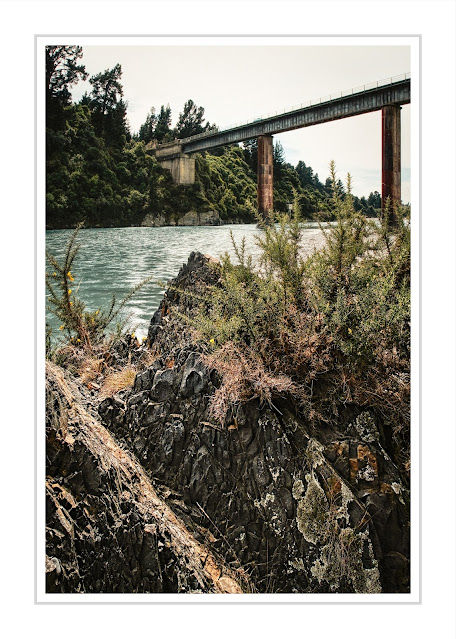
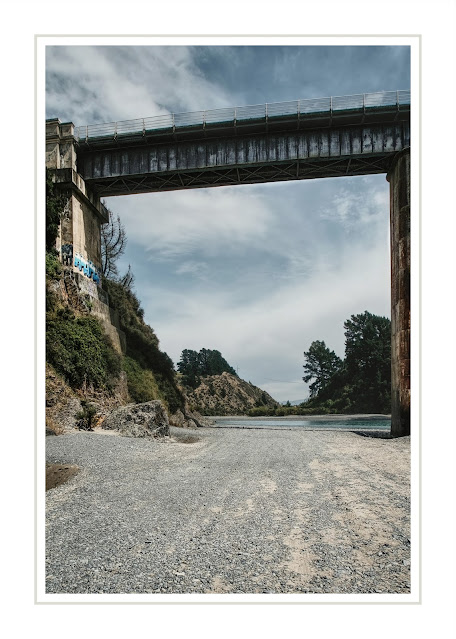
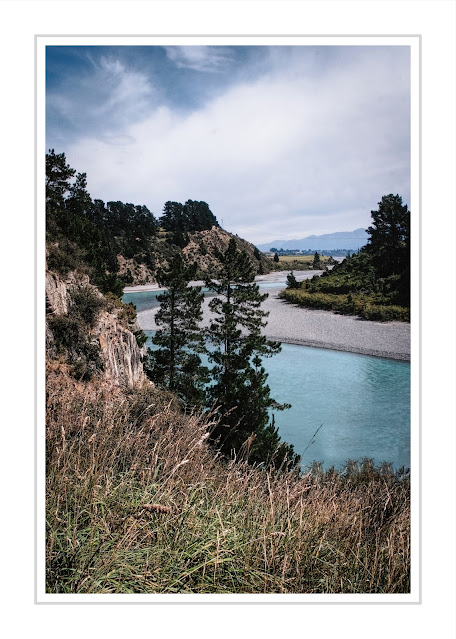
The Waimakariri Gorge bridge
(originally built for rail, now a road bridge)


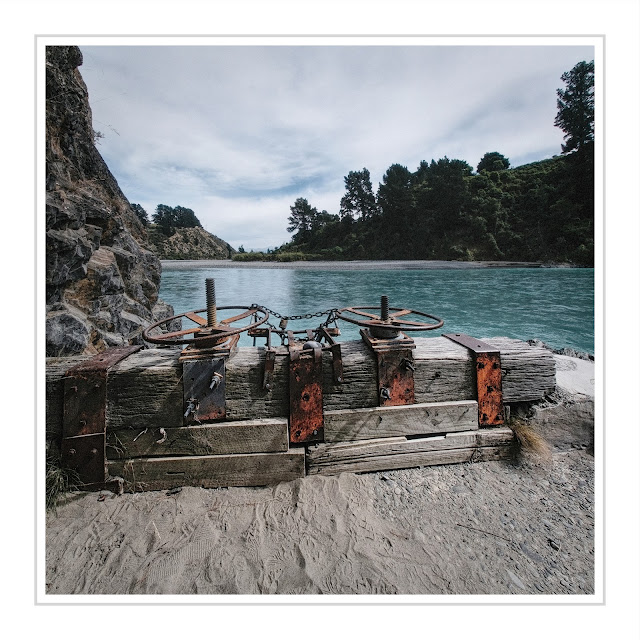
The intake


From the intake

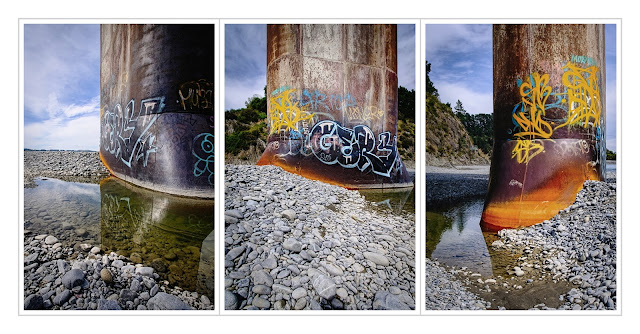
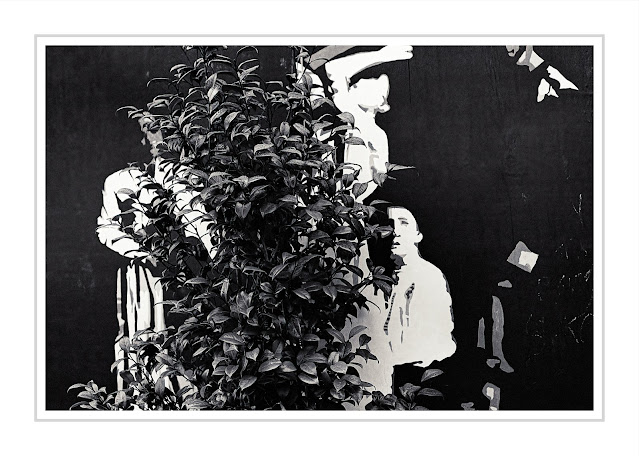
Graffiti tryptic


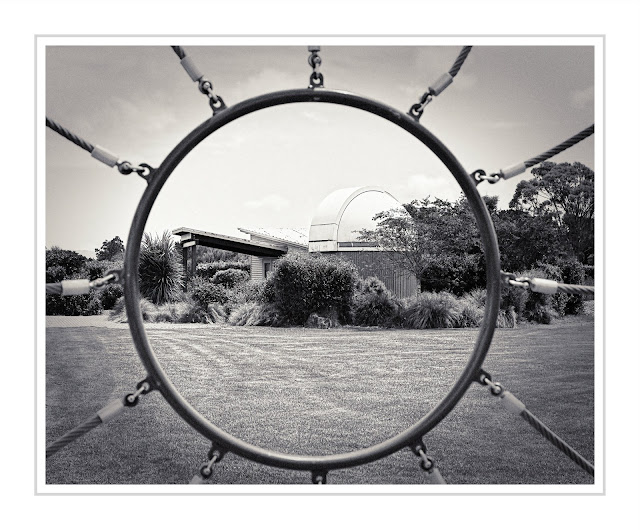
Framing the up-river


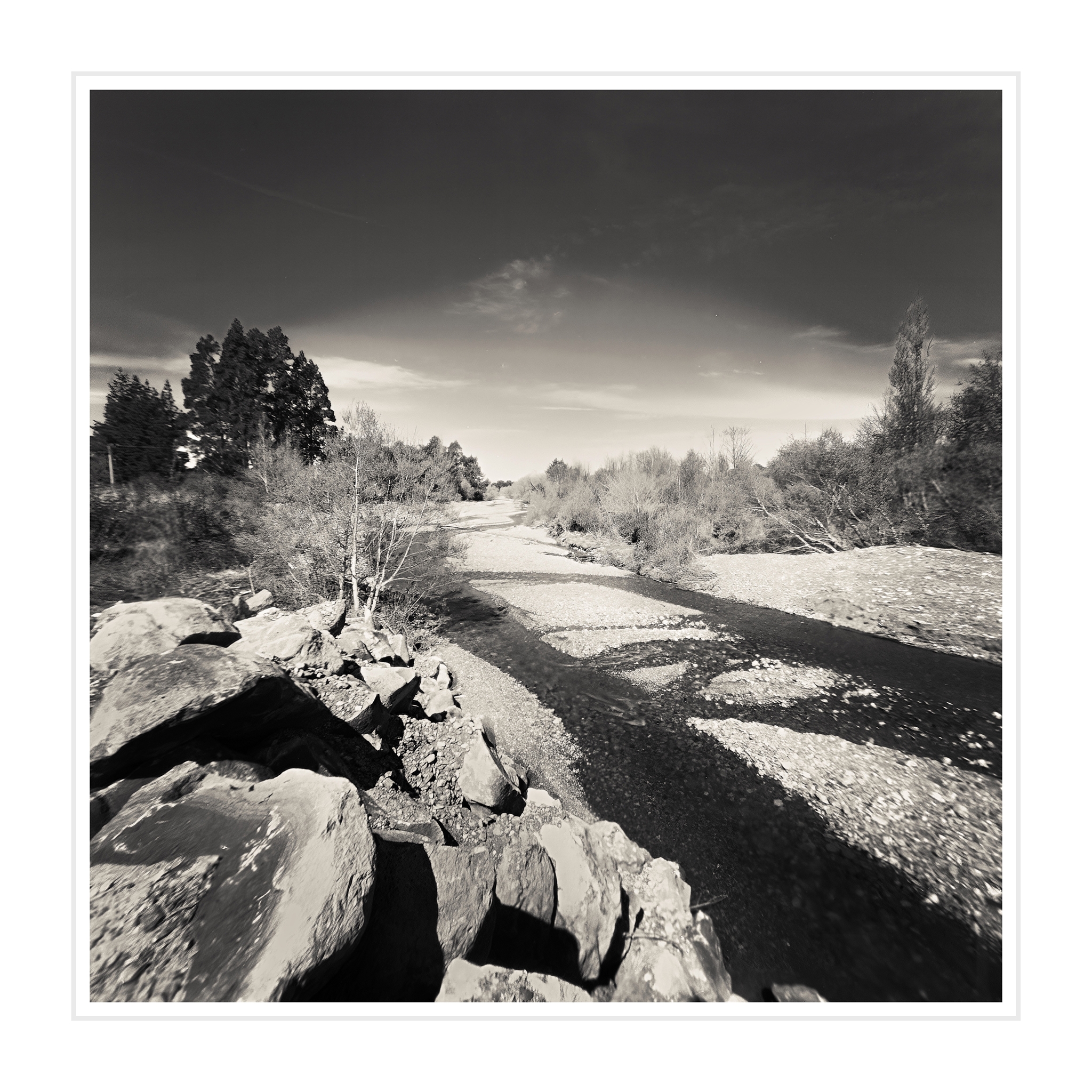
Up-river from the Gorge
(yes, the water really was that colour)

Oh, and when I left for home, two fishermen arrived and cast their lines just downstream from the bridge. I wonder what their luck was like?

Saturday, January 1, 2022

Not a resolution ...

More a statement of intent really;  a new photographic focus for 2022. There's a list of reasons far too long to go into here but, in 2022, I'll be shooting mainly on film, mainly black and white and mainly developed at home. The last couple of months have been spent assembling equipment and refining processes but, for 2022, it's back to my photographic roots to reprise the past with the benefit of sixty years of hindsight.

I cut my photographic teeth on black and white film photography, but put it behind me too soon for the sake of colour and, later, digital. I'm pretty sure that I didn't learn enough of what black and white should have taught me before I moved on, so it's back to the beginning to finish what I started back in the 1960s. In part, I've been inspired by the work of Martin Henson (https://www.martinhensonphotography.co.uk) if only because his outstanding work holds out the promise of the possible.
They say that "there's no fool like an old fool" and I guess that's something I'll have to wear while I make this journey. But it's a long-time itch which, it seems to me, I might as well scratch and, if not now (at 73), then when? "Make hay while the sun shines", seems quite a compelling aphorism at my age.
So, I've been testing equipment and trying out processes. These test shots were all taken on Ilford FP4 but, along the way, I'll probably try some other emulsions as well. Developing film in coffee (a.k.a. "Caffenol") seems to work quite well and, being a somewhat quirky approach, appeals to my New Zealand induced "Number 8 wire" mentality.
Anyway, I think I might have fun seeing where this takes me. Will it last the year? Will it run beyond 2022? Who knows where this path might lead.
Here's to a happy New Year, everyone!


Saturday, November 6, 2021

Mea Culpa

So, I build a pinhole camera out of a broken Ensign Selfix. Then, to test it, I load a film I had never shot in a pinhole camera before (long exposures). Once I had taken all the shots, I decided to develop the film myself (for the first time in about 50 years) and to try developing it in coffee (yes, that really is a thing). Of course, what I should have realised, is that I would have no way to tell whether any problems were the camera, the film, my ancient developing skills, or the coffee? One variable at a time, Einstein, one variable at a time.

And so it was that I found myself standing in the bathroom, staring at a wet strip of 120 film, comprising eight, very dark (almost black) frames, wondering what on earth had gone wrong.

Fortunately, Son of Ep, the scanner, was able to see more in those dark negatives than I could, though it was all pretty close to the scanner's own noise floor. Nevertheless, there was enough to see that the camera didn't have any light leaks and that the image was as sharp as a pinhole camera is allowed to be. The film also hadn't been fogged by my clumsy blind transfer to the development tank in an ancient dark-bag.

What I did find, was a combination of over-exposure and over-development of the film. Well, at least the coffee works - just a lot better than I had envisaged! And, to prove the point, here is our local observatory excavated from the dark matter of a black (pin) hole:

Pinhole camera, yellow filter, Ilford Delta 400, 15 mins in Caffenol (much too long).


Wednesday, October 20, 2021

Through the pinhole

A year or so ago, I started dabbling in old film cameras. Not the cult film cameras that still cost thousands of dollars, but the 'cheap as chips' cameras that can often be had for a hundred dollars or so and, preferably, have no electronics. It has been fun exploring some of the cameras that I could never have afforded back in the 1950s and 60s when I was starting out in photography. But, I thought, why stop there?

Kornel, is in Budapest. He makes pinhole cameras that are simple, cheap and very well built. His business is called "Infinie Camera" and, global mail delays notwithstanding, he sent me this beautiful little pinhole camera from his Etsy store...

6x6 pinhole camera, f130 pinhole at 32mm.

The camera arrived well ahead of the film stock I had ordered from Melbourne, so I set the camera aside and exercised my patience while I waited for the film to arrive. Finally, the camera and film were both in my hands and a nice spring day called for a bike ride. The pictures were shot in colour on Ektachrome but, in deference to the pinhole aesthetic, here they are in black and white ...
Pearson Park, Oxford
Farm entrance, Coopers Creek
Bridge, Coopers Creek
Coopers Creek
Woolfs Road ford and swing bridge
Derelict swing bridge, Woolfs Road
Unnamed ford, Island Road
Eyre River, Harewood Road

But, I can almost hear you asking, don't pinhole cameras produce rather fuzzy pictures? Why do these look so much sharper? Well, it's part of an experiment: What happens when you marry old technology with modern computers? These pictures are not really that sharp, but they are much sharper than a pinhole camera can produce on its own. The results are a blend of the pinhole's simplicity and infinite depth of field, with modern, AI, computational photography. I'm sure I can't be the first to have thought of doing this, but I like the results enough to want to follow this path a little further. Your thoughts?


Thursday, July 29, 2021

One month in

Today is my 73rd birthday and one month since I finally retired from paid employment. It's going well so far, but a month is a bit quick to pronounce everything all 'good.' When you have been used to people expecting you to turn up for work for the last 57 years, it comes as a bit of a shock when that is no longer the case. Even though I had prepared, by working only part-time for the last 13 years, the absence of the weekly work requirement still feels like there's something not quite right. 

Birthday lunch in Methven

A lot of things have been accomplished this last month (so there has been no laziness!) but they have been done without pressure and at a more relaxed pace. It's this ability to, largely, choose the task that I feel like doing at the moment (rather than the multiple tasks that all need doing a.s.a.p.) that makes each day so much more relaxed (at least so far). 

Lots of walking  


Weather permitting, there have been walks, photographs taken, chats over the fence with the locals and even the pleasure of watching others hard at work.

Meet one of the locals

My 'office' has already been relocated to another room, and the old PC has been replaced with a new Apple Mac - that took over a week and felt more like moving house; I still haven't 'unpacked all the boxes'. There are plans for some house alterations and a holiday booked for after the worst of winter should have passed. So, no room for boredom yet.

Watching others work, down at Mill

All in all, after the first month, I am quite upbeat about this retirement thing working out for the best. Hopefully, my optimism isn't misplaced.


Friday, November 20, 2020

Picture a haiku

 It is often said that a picture is worth a thousand words. The idea with "Picture a haiku" is not to replace words with a picture but to combine words and picture so that they tell the same story.

The form of a photograph is simple and constrained; a four-sided rectangular frame filled with a subject. A narrow window to a much larger, 360-degree world. A photograph is about inclusion and exclusion - what is shown and what is implied but not shown. The haiku is equally simple and constrained; just 17 syllables arranged in three lines of 5-7-5. It too is filled with a subject, it too is a small window to a much larger idea - inclusion and exclusion. 

What if, words and picture, the subject was the same; image and words playing the same melody, dancing to the same tune? An experiment. Let's see where this goes ...


Splashing colours fly
Reproductive insect art
Makes next year's daisies.


Five A.M. bird song
Welcoming the lightening sky
Today, I might fly.


Sun-kissed leaves waving
Tall Sentinels line the way
A guard of honour.


Greenly, I kept you
Now, without envy, it is
your time in the sun.

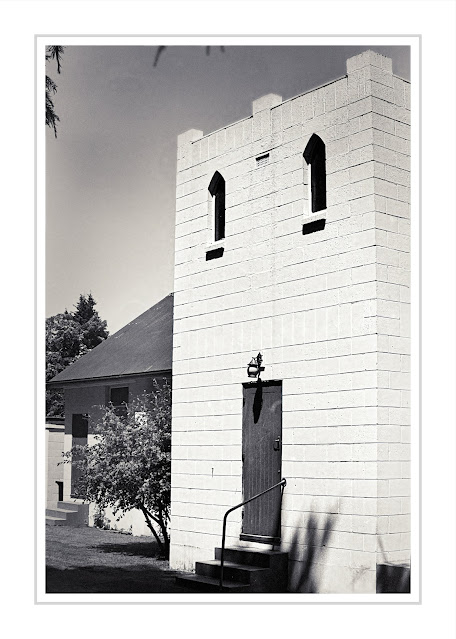
Standing neglected
Once breathing horses and hay
Now, ghosts of time past.