Showing posts with label camera. Show all posts

Saturday, June 20, 2026

Real Photo Postcards - an early Instagram

As a life-long photographer, I am ashamed to say that I had never heard of "Real Photo PostCards" (RPPCs). RPPCs, it turns out, were the original 'Instagram'. Perhaps a little less "Insta" but filling exactly the same social purpose, a century before Instagram invaded our phones and eyeballs. RPPC pictures were of your life; the words, short descriptions and wishes for a friend or relative. Your personal 'feed' was probably an old shoe-box.
A sales brochure for the "3A Folding Brownie"
 
 It was 1903 when Kodak brought out the "3A Folding Brownie". It used a 122 format film that produced up to ten postcard-sized negatives (3.25" x 5.5") on a cartridge. These negatives could be contact printed onto postcard-sized photographic paper with a pre-printed postcard-style backing. Write your message, address the card and post. 
 
In those days, there were strict requirements for postcards; they had to be a certain size and, initially, the reverse side could only contain an address but, in 1902, UK regulations changed and the reverse was split in two, permitting both the address and a short message on the back.
The "Real Photo" part of their title was intended to differentiate these photo postcards from commercially mass-printed postcards. RPPCs were (almost) unique and very personal. So ubiquitous was this style of postcard that many were never sent through the post, but were simply printed and kept as personal photographs with annotations on the back. 
This one, from 1924, was probably sent as part of a larger 'care package' to a father working away from home.

Clearly, some commercial photographers offered RPPC prints as part of their portrait service. The following, 1919, example is one of two copies of the same picture, but with different reverse sides:
 
For the modern observer, there's something deeply evocative about the tactile connection represented by these cards. The "Real Photo Postcard" aesthetic isn't just about the chemistry of the print; it's about the weight of a message intended for a specific set of eyes. It’s a reminder that while our tools have evolved from silver salts to digital pixels, the core human urge to say Here I am, and I wanted you to see this, remains exactly the same.

So, there you have it; Real Photo Postcards - the early 1900s "Instagram".


Wednesday, February 22, 2023

This camera is a mutt

... and I love it. It's also a camera with history.

As a user of vintage cameras, there was a time when I wanted an older Leica. The Leica name is synonymous with excellent build quality (and stratospheric prices). But, as time went on, I became aware that all was not necessarily perfect in Leica land. Those prized, early, Barnack Leicas, had issues that made them less than perfect working cameras. Nice to keep on the shelf perhaps, but not so nice to be taking photos with. (See here for a rundown of the issues: https://petapixel.com/2022/12/21/barnack-quirks-an-intro-to-shooting-with-early-35mm-leica-cameras/)

In 1930s  Germany though, there was a camera specifically designed by Zeiss Ikon to out-Leica the Leicas of the time. The Contax was designed to be everything a Leica was and then some. While the first Contax suffered from being somewhat rushed to market, it was the Contax II from 1936 that delivered the goods, beating Leica with an integrated viewfinder/rangefinder, better shutter mechanism, faster shutter speeds, better film loading, and a significantly more accurate rangefinder. 

The original Contax II from 1936

The Contax II became a much sought-after camera for working professionals, especially press photographers, who needed a small camera which delivered great image quality and was able to take the punishment dished out in daily use. Production of the Contax in Dresden survived the war years and continued post-war until the Russians dismantled the factory and moved the manufacturing plant and most of the German engineers to Kiev in Ukraine.

Production of the Contax continued in Kiev using the same machine tools and technicians as in the Dresden factory. Nothing changed except for the name - Contax was dropped in favour of the name "Kiev" after the city in which it was now produced. Some of the early Kiev cameras still had "Contax" embossed on the inside of the front plate.

My copy of the Kiev 4a - the flash sync port was a later addition.

Production of Kiev cameras continued largely unchanged for the next 40 years. They progressed from Kiev to Kiev2, Kiev3 and Kiev 4 with only minor changes until production was finally terminated in 1987. During the 1980s, the quality of the Keiv cameras started to suffer as a result of ageing machine tools and the loss of all the original Contax staff. It is rumoured that, in the 1980s, whole batches of Kiev cameras were dumped because they didn't pass quality control. 

The Kiev 4a - opened for loading film

As a camera from 1977, the Kiev is not very impressive - most cameras of the era were much more sophisticated. But, as a camera designed in 1936, it was already streets ahead of its Leica contemporaries and makes a very useable camera for anyone who knows their 'f' stops from their shutter speeds. I took it for a walk around our local school to test it out and came away impressed.

Kiev 4a, f8 @ 1/125, Ilford FP4

So, my replacement for the Leica which I can't afford is a Kiev 4a. Basically, a 1936  camera designed by Contax in Germany but built in Kiev in 1977. If this camera were a dog, it would be a mutt.

(Support Ukraine; buy an old Russian camera.)

Thursday, January 12, 2023

OlyPen II

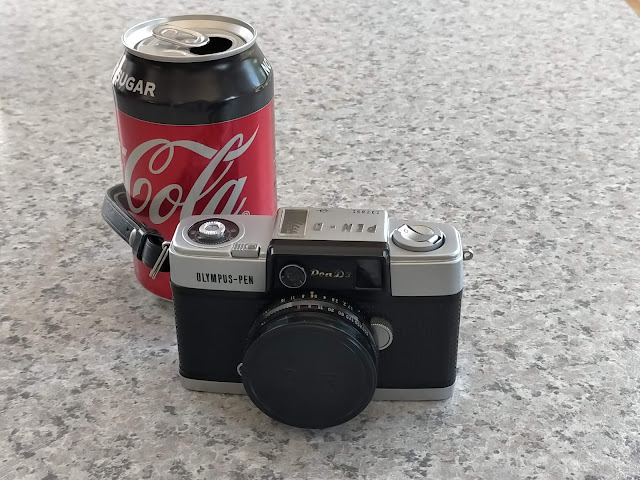
 It was just before Christmas 2021 that I got my first Olympus Pen half-frame camera, an Olympus Pen D3 (https://misc.fords.co.nz/2022/01/olympus-pen-d3.html). I ran several rolls of film through that camera and, at the time, loved using it more than any of my other cameras (film or digital). The 32mm f1.7 lens was remarkably sharp and I got amazingly crisp and clear pictures from such a small frame size. Then, one day, the ‘click’ didn’t, and on investigation I found the shutter blades lying in a heap in the middle of the lens. The OlyPen had died.

Christmas 2022, bought OlyPen II to my door. It is a Pen EED model with fully automated exposure and that same 32mm f1.7 lens that I loved on the Pen D3. The Pen EED was manufactured between 1967 and 1972, though you wouldn’t know it to look at my copy. It has a much more modern design than the Pen D3 and I was fortunate to find one in immaculate condition.

Olympus Pen EED (1967-1972)

Aside from being small and portable, all the OlyPens, and most half-frame film cameras in general, have one unusual feature - when you hold them naturally, they take pictures in the portrait orientation, rather than the more common landscape. If you want landscape on an OlyPen, you must turn it sideways. 

This portrait orientation is no minor detail. It wasn't until I first used the OlyPen D3 that I realised that I naturally preferred portrait orientation. This natural preference, however, had always been suppressed by the poor ergonomics of holding my other cameras sideways. Once I used the OlyPen, I went from 80% landscape to shooting 95% portrait. The portrait orientation also lends itself to a diptych or triptych series in a way that landscape pictures don't. 
At the skate-park

Being half-frame images, the negatives from the OlyPen are never going to hit the heights of medium format for quality, nor even a good full-frame 35mm camera, but that isn't the OlyPen's purpose. The OlyPen is a carry-everywhere snapper - if artists carry a sketchbook, then the OlyPen is the photographer's sketchbook. Having said that, the OlyPen produces 20Mp scanned images that easily hold their own on social media and anything up to an 8"x10" print; thanks largely to that wonderful Olympus lens.
Mexican dominoes

I expect to have a lot more fun playing with the little OlyPen II. Hopefully, it will last a lot longer than my broken D3 before it gets taken to camera heaven.
Playing in the playground with the OlyPen

OlyPen photos were taken on either Fomopan 100 or Ilford FP4, developed in Rodinal, semi-stand for 1hr.


Saturday, November 26, 2022

I’ve been bad; very bad

After trying, with only partial success, to cull my camera collection, I ended up returning one camera to active service, buying another camera, and had a third camera boomerang back, from 2012. This probably isn’t good.

Originally, I had put my Fujifilm X-M1 up for sale, but it sat without interest over the winter months. Then, on a whim, I decided to send it away to be converted to infrared. It came back from Oz at the end of October, just as we were leaving for Oamaru. 

A B&W infrared picture taken in Oamaru public gardens. River in foreground, trees on oposite bank reflected in water.
Oamaru public gardens - Fujifilm X-M1, 720nm Infrared.

I loved the results, so that’s one camera that's now back on active duty.


Probably, my greatest sin (though not the most costly) was pressing the “Buy Now” button on a Fujifilm FZ-3000. This is a somewhat bizarre-looking film camera from the early 1990s. My excuse was that it was brand new and still in its original packaging - a rare find for $60.


Auto everything, the camera was light to carry and simple to use. When I want to shoot 35mm film without the hassle of carrying around the Nikon FE, this is surely the camera to use. 


A B&W picture of the West Oxford Hotel, built around 1860 timber with weatherboard cladding.
West Oxford Hotel - Fujifilm FZ-3000, Ilford FP4+, Rodinol.

Unsolicited, my son returned the Nikon D80 that I had given him in 2012. He had replaced it several years ago and it had been sitting unused ever since. Who wants a 10Mp digital camera in 2022?


Nostalgia beckoned and, after kickstarting the battery into life, I took it out for a walk. Low expectations here. But, what I hadn’t factored into my thinking was that software has improved leaps and bounds since I last used this camera.


So I ran the 10Mp files through Topaz Photo AI, and out popped some stunning 40Mp images that compared very well with my current cameras. I was a bit gob-smacked, to be honest.


A view of Mt Oxford across playing fields. Blue sky, white fluffy clouds.
View to Mt. Oxford, across Pearson Park, Oxford, NZ - Nikon D80.

Now I’m in a bit of a quandary; I have a perfectly usable DSLR camera which won’t be worth much (because, low specs) but produces beautiful images for anyone with the right software (e.g. me). Should it join the other nine cameras on active duty, each wagging their tails like dogs in a pound awaiting adoption?


What to do?

Saturday, January 8, 2022

Olympus Pen D3


Until you hold an Olympus Pen camera in your hand, it is hard to imagine just how small they are.  Pictures show a perfectly proportioned 35mm film camera (which it is) but in the hand, it is quite diminutive - smaller even than my everyday digital Fujifilm cameras, the X-M1 and the X-E3 (themselves quite small).

The "Oly-pen" arrived just before Christmas and it took a couple of weeks to run through the first roll of film - not least of all because a standard 36 exposure film can accommodate 72 shots in the Oly-pen's half-frame format.  I had been concerned that the quality of the images, given the smaller negatives, wouldn't meet my normal standards. Usually, I get clean 24Mp images from standard 35mm film and, rather surprisingly, I found that the Oly-pen produced equally clean 20Mp files in a 4:3 aspect ratio (despite its size disadvantage).

That first roll was a resounding success - despite this photographer's mess-up. Knowing that the light-meter would be reading incorrectly (due to an incorrect voltage battery) I compensated by adjusting the ISO. Only, dingbat that I am, I adjusted the ISO the wrong way, resulting in 72 frames that were about 3 stops underexposed. Despite this, the rescued shots all turned out remarkably well and demonstrated that the Oly-pen was a very useable camera.

Manufactured between 1965 and 1969, the Oly-pen D3 makes a great street camera, it is discrete and, using zone focusing, quick to use. With the appropriate exposure dialled in (not necessarily too accurately!) and the focus set, taking a shot is a simple wind, shoot ... wind, shoot, affair with an almost inaudible 'snick' as each shot is taken. 

Given its small size, ease of operation, fast and sharp f1.7 lens, and immense 'fun' factor, the Oly-pen is destined to become my everyday, casual photography, film-favourite.

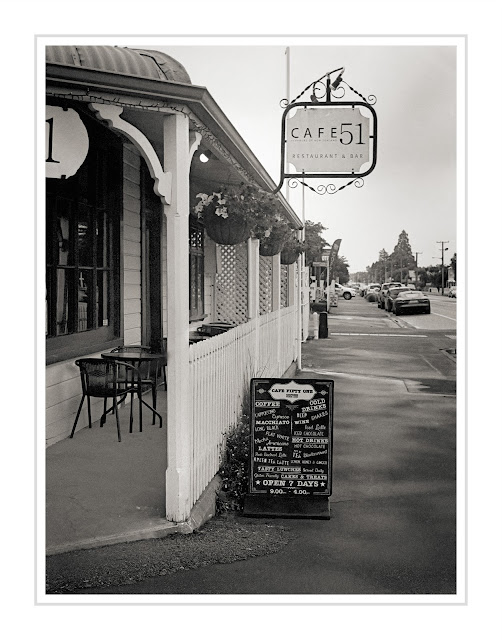
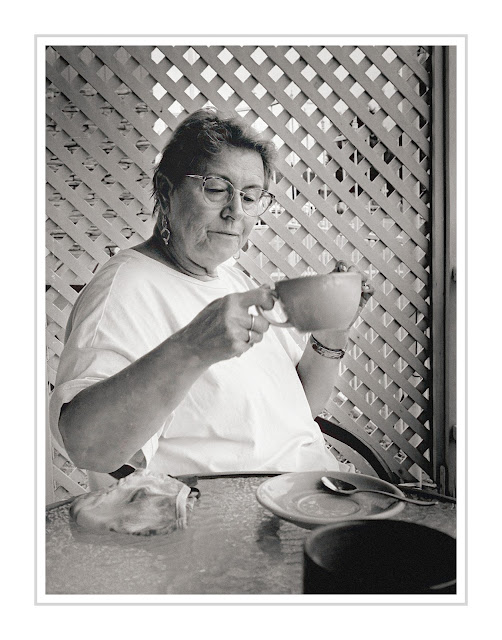
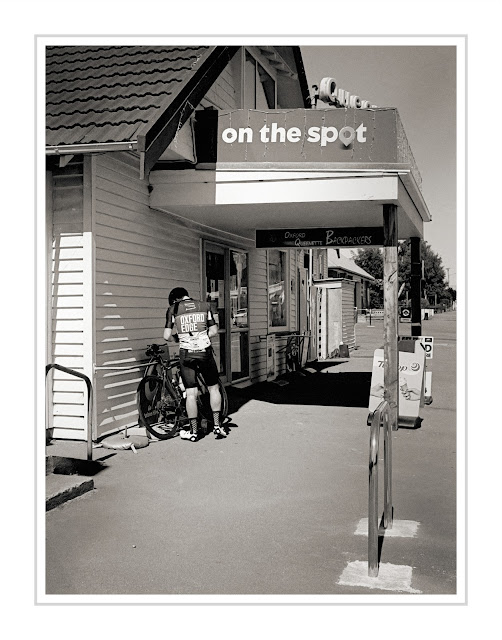
Photos (except the first) were taken on Ilford FP4, developed in 'Caffenol' for 8 minutes, scanned and processed in Exposure X7.


Wednesday, April 14, 2021

Using the Minolta Hi-Matic 9

 Back last November, I wrote about another film camera arriving. Well, I never got around to showing the pictures - better late than never, I suppose!

After checking over the Minolta Hi-Matic 9, I loaded a roll of 35mm Kodak Gold film (ISO 200) and went for a walk around the town. Except for one shot, I left the camera on Auto to test how well the light metering worked. More about that later.

Preparing the camera


Loading film into the Hi-Matic 9 was straightforward and as easy as most other 35mm cameras of the era. The film winding lever has a longish throw but is sturdy and smooth, coming positively to a stop when the film is wound on. It provides confident feedback that everything is just as it should be in the film winding department. The shutter is locked after each exposure and is only activated by winding on the film, so no double exposures here - intentional or otherwise.

Underneath the lens is a small lever that activates the metering system and sets the ISO speed of the film being used. Before shooting this has to be positioned from "OFF" to the ISO of the film in use. Once this is set, there is a battery check procedure, accessed by turning all the dials on the lens (shutter, aperture, focus) to the "check" mark. If the needle in the viewfinder hovers in the correct position, then the battery is good and the metering should work correctly.

Using the camera


With the camera set to auto, using the camera is simple - compose, focus, shoot. There really isn't anything complex here and the digital photographer might only be thrown by the lack of autofocus. The viewfinder, is a typical rangefinder, split-image type. Bring the two images together and you will be in focus. If you are not used to rangefinders, it may take a little getting used to but, once you know what to look for, focusing is both quick and accurate.

Setting a fixed focus for quick-action street shooting using zone focusing, is also possible but there is no depth of field scale on the lens, so you will need to know what you are doing or reference the camera manual for a depth of field scale (p27). Also, the focusing ring moves quite freely, so it is easy to knock out of focus if you aren't careful.

Like the long travel film advance, the shutter release also travels through a long distance (11-12mm). It takes a little practice to release the shutter smoothly as the tendency is to jerk the finger down forcefully after the first few mm of inaction. A hair-trigger this isn't, but practice makes perfect.

To change from completely auto mode, a lever on the lens needs to be depressed and a shutter speed selected. With the aperture ring still set on auto, the camera will choose an appropriate aperture to match the shutter speed. Moving the aperture ring from auto, puts the camera in fully automatic mode with camera settings under your complete control and the EV meter in the viewfinder to guide your decisions. Whatever your skill level, there is a way of using this camera to suit.

The results


I am pleased to say that every shot on the roll ended up correctly metered by the camera. However, the shortcoming of this fully automatic system is that the camera settings are adjusted on a scale from 1/15 sec at f1.7, up to 1/500 at f16 and there is no visual feedback that allows the user to know what settings are in use. Consequently, at least one exposure of a dark scene was made with a very slow shutter speed and camera shake was evident in the final result. Lesson: once the light begins to fail, take over control of the camera, or make sure that you have a high ISO film loaded.

Personally, I like the results; there's a quality to the colours that is quite different from digital and the highlight grading in cloudy sky is, again, hard to replicate with a purely digital image. The scanned images were sharp and got similar post-processing to my digital images. So, all in, the Minolta Hi-Matic 9 and Kodak Gold 200 film, get the thumbs up from me.


Saturday, February 27, 2021

Out of sight; out of mind

As a visual sort of person, I identify strongly with this old adage. If I can't see it, it probably doesn't exist. Papers belong in stacks on the desk or shelf - somewhere I can see them but definitely not in a filing cabinet. Clothes only belong in draws while waiting for the next season and my cameras lay in wait in various nooks and crannies around the house. 

So it was, with a growing awareness that I needed to be a more tidy Kiwi, that I was on the lookout for a glass-fronted cabinet for my camera gear. And behold, in the fullness of time, one came my way, unbidden, and I started to place my cameras therein.


If you had asked, prior to the cabinet, how many cameras I possessed, I would probably have said, "three or four" (I had recently been through the trauma of selling one, so I knew the numbers were down). But, as I placed the twelfth camera in the cabinet, I began to see the problem: I'm a collector/addict (depending on who you ask). Six of these cameras are film cameras - one of which I brought only last year; all bar one have been used in the last twelve months, two still have film loaded.

Now that I can see them all, I am more mindful of my camera obsession: in sight; in mind (perhaps I should keep them in boxes after all?)

Sunday, November 8, 2020

Another film camera arrives

The dear lady that gave me the Kodak Retina Reflex, turned up again the other day with another gift - a camera from the thrift store where she works. I'm warming to the idea of her bringing me a camera every now and then - I get to check the camera out, find out where it fits in the history of cameras and, if it's functional, run a roll of film through it. Nice.

The previous Retina failed the film test. I got some pictures off the roll, but the film winding mechanism was unreliable and there were gaps and overlapping frames. It could be fixed with a good CLA, but is not worth the cost (probably over NZ$300). So, with that experience, I didn't have high hopes for the camera in the case marked, "Minolta".

The Minolta Hi-Matic 9 from 1966

Inside was a 35mm, Minolta Hi-Matic 9, apparently owned previously by Ian H Thompson of Oxford. I discovered that he died in 2009 so it's probably been sitting around unused for a few years. What I feared was fungus on the f1.7, 45mm lens, turned out to be nothing more than dirt and cleaned up nicely. What was more surprising was finding that the (now obsolete) mercury coin-battery still worked, as well as the light meter,  shutter and self-timer.

The Hi-Matic 9 is a brick of a rangefinder, weighing in at about 760g. Minolta's Hi-Matic range started in 1962 and the H-M9 came out in 1966. Cameras bearing the Hi-Matic name continued until 1984 though the last, the GF, was a cheap plastic job with a slow f4 lens - not at all up to the quality of the earlier Hi-Matics. In 1966, the H-M9 would have cost about US$110 or about 6 month's worth of my wages as an 18-year-old. So, not a cheap camera.


The H-M9's key feature at the time was an automatic exposure system. The camera had a light sensor built into the lens housing and, when set to auto, would calculate the correct exposure. It wasn't a particularly sophisticated system, gradually ramping both aperture and speed from 1/15 sec @ f1.7 all the way to 1/500 @ f16. If the user wanted more control over aperture or speed, then they needed to switch into manual-mode to override the auto function. Minolta dropped this system in the next model (H-M11) opting instead for a shutter-priority automatic system.

The HM9 is about to get the film treatment, and I intend to give the automatic exposure system a workout to see how it stands up in 2020.

On a different note; today I managed to get a shoe on my damaged foot. So mobility is restored and I will be spending much less time sitting in front of my computer and more time out shooting!

Saturday, November 7, 2020

Grokking the X-E3

1/1300, f5.6, ISO 200, 42mm

Warning! Fuji X-nuts only beyond this point.

Since getting the Fujifilm X-E3, back in June, it has been fascinating to work out how, exactly, I wanted to use it. Of all the digital cameras that I have ever owned (including full-frame DSLRs), this is, by far, the most versatile and fascinating - simply a joy to use in so many situations. 

But, all this versatility comes at a price - the mental agility required to both remember and use a seemingly endless permutation of settings through dials, menus and touch screens (just like most prosumer digital cameras). At times, it can all be a little overwhelming for this septuagenarian. My solution may not suit everyone, but I have simplified my X-E3 to the camera I need it to be: I shoot in one of only two modes - accessed by the flippy, auto lever on the top of the camera - Auto and fully manual. 

1/480, f5.6, ISO 200, 45mm

Auto is what Fuji make it; it shoots fantastic JPGs without any fuss. Press the shutter. Done. Fuji says it's great for handing off the camera to someone else, I say it's great for family snaps, walking the streets or anything when I don't want to think too hard about the camera in my hand. 

The second mode is fully manual. I use it when I'm playing 'photographer'. It is set to RAW, manual focus (rear dial focus assist, front dial aperture and ISO). Fn switches electronic and manual shutter. No menus are required while shooting - not even Q. This works for me because I can transition between the X-E3 and my vintage film cameras seamlessly. The dials and levers may be different, but the decision-making process is just the same. If for some reason, I want assistance from autofocus, then the 'C' and 'S' lever is by my finger, without having to take my eye from the viewfinder.

1/1000, f6.7, ISO 12800, 230mm

With the body sorted, that just leaves the decision of what gear to carry:

  1. Pocket - body and XF27mm f2.8 - gives me a mini X100 for street and walkabout
  2. Small bag - body, XC15-45 and XC50-230, +accessories - covers 95% of everything else

Simplifying in this way helps me to put the focus back on the picture-making process, rather than the tools I am using. Taking a picture is either easy or mentally engaging; my choice. And photography remains fun, rather than an exercise in finessing the technology. 

1/15, f22, ISO 6400, 45mm+tubes

In a long line of cameras, the X-E3 is my first Fujifilm - and I'm loving it. It brings a new level of pleasure to using a digital camera.


Friday, October 2, 2020

Bargain or bust?

The courier is due today, bringing an old camera which could either be a bargain or a bust. Well, perhaps not a bust, but at worst a non-working display item. To be fair, I paid a display item price but there is still that hope of an inexpensive, working, camera worth, perhaps, 3-4 times what I paid. 

The camera is, I believe, an "Ensign Selfix 820" - a British camera from the mid-1950s. The seller simply described it as a "Vintage / Old Camera Comes out at front in leather case". Now, either he doesn't know his vintage cameras, or he is a wily trader casting a fly. My research leans towards the former, but not with any great degree of certainty. So, a bargain or a bust? I should find out today. {continued later}


Opened the package with some trepidation and found inside an Ensign Selfix 820, as suspected. Cosmetically, it is a beauty; not a mark on it and all the leatherette looks pristine.  "Made in England" (you don't see much of that these days) proudly engraved on the winder knob and all distance scales in feet. Opening up the back, I find the two masks inside that convert the camera from 6x9 to 6x6(cm) both present and correct, as well as some minor rust spots on the film rollers which I will attend to later.

The big worry, in my head, was the shutter; but it works at all speeds including 'B' and 'T'. Accuracy will have to be determined later. There is haze and some small fungus marks on the lens, so I take out the rear element and give the lens a good clean - all becomes crisp and clear. The bellows seem to be in good condition with no light leaks but a roll of film through the camera will soon confirm that.

This camera is as close to "mint" as any used 60-year-old camera can be, and the value according to Collectiblend is about US$250; I paid US$50 or about 1/5 of the going price. So, I'm calling "bargain" on this one.


Thursday, September 17, 2020

Retro-mechanical


I'm a digital photographer. When it comes to technology, I have always been there waiting with open arms to embrace the new. I think I last shot film about twenty years ago when I started my digital journey with a sub-one-megapixel Kodak camera. But, when someone recently gave me a 1958 Kodak Retina Reflex in working condition, it caused a rethink. Now, some people extol the virtues of film over digital – they like the 'film look' or the experience of developing and printing film. I understand that. And, of course, to use a mechanical camera is to use film; but it wasn't the film that caused my rethink, it was the camera.

Whether mechanical or digital, the fundamental aspects of photography don't change. But, using a mechanical camera again, I realised that digital had distanced me from many of those fundamentals. With a mechanical camera, everything is in your face - from the weight of the camera (heavy) to the need to think carefully about subject, composition, light, juggling f-stops and shutter speeds, and dialling in a good focus. The sheer immersion in the detail of the picture-making process made me feel an integral part of that process – one with the camera and with the act of making a photograph. I had forgotten that feeling.

With digital, if I want, the camera can handle almost everything. My input is only necessary for the occasional circumstance when I needed something quite specific and different from what the camera will automatically provide. What is worse, subject selection and composition – perhaps the most important domain of the photographer -  has been demoted; digital allows me to shoot everything, any way I want, at no marginal cost – choices can be made later. Even Cartier Bresson's "decisive moment" has been reduced to a function of multiple frames per second. In a commercial context, these are all advantages for digital but, for the photographer, they began to look more like separation from the process and a limiter on personal growth and development.


So, this old mechanical film camera requires me to become more a part of the picture-making process - to engage my brain and make several deliberate choices which will either make or break the picture. The pushing of the shutter release is a final commitment to all the choices made, in a way that it seldom is with digital. And I began to wonder if it isn't in the making of all those appropriate choices that a camera-user becomes a photographer? And, if that is the case, then how was digital making me a better photographer? Perhaps it wasn't, and perhaps that is what is behind many photographer's fascination with the next best camera - some of us have needed to get better cameras because our cameras aren't helping us to become better photographers.

I'll keep shooting digital (because, convenience) but I think I might just have found a very good reason to also shoot film, in a camera that requires no batteries. Definitely retro-mechanical.


Thursday, January 1, 2015

The Last Camera

The last camera I brought was not a rip-roaring success. It was a Panasonic LF1 - I wanted it as a go anywhere accompaniment to my full-frame DSLR. It seemed to tick the right boxes (very small, RAW shooter, EVF) and the reviews were quite good too. But, in use, it never met my expectations for image quality.

Of course I knew that the LF1 wouldn’t produce full-frame quality (or even close) but I soon found that the RAW files just seemed to lack spunk. Whenever I went to develop one, it felt like I was having to give it CPR with Lightroom, just to get it looking average. It wasn’t just the sensor noise (evident even at the lowest ISO) but a general flatness and lack of detail that no reasonable amount of sharpening or clarity seemed able to overcome.

I don’t think I ever had a frame out of that camera that made me whoop for joy. In the end I just didn’t want to pick it up - it was like having a friend who always turned up at your house feeling miserable; guaranteed to lower the spirit of any occasion. Who needs a camera like that? The LF1 did, however, prove that a camera of this size is a useful thing to have - if only it could produce better images! So my search continued for a compact camera that I would be happy to use when not toting a DSLR. And I am now confident that I have found it.

In the last couple of days, I have processed well over a hundred RAW files from this compact and I am in awe of its capabilities in both general, low light and high dynamic range situations. Perhaps that is why all the reviews unanimously rate it as the very best camera in its class. It’s also almost the same size as the LF1 (just a little thicker).

So, after weeks of research and waiting for the mail man, my Sony RX100 iii is now firmly in my hot little hands (thank you wifey)- this one could be the elusive Last Camera for this aging photographer. Play time!
Taken with the Sony RX100 iii, 1/125sec, f4.0, ISO 125 - RAW file processed in Lightroom.