I am enjoying resurrecting these old 35mm slides. Slides produced the original SoC (straight out of camera) shots. There was no opportunity to massage or post process; what the camera put onto the film was what you got. Revisiting these pictures over 40 years later and with modern post processing tools, allows a fresh interpretation unfettered by any memory of what it actually looked like on the day. The results tend to be more interpretive, perhaps a little 'painterly' - especially as these old slides lack the detail we have come to expect from modern digital cameras.
One thing I have noticed in these old photos, when comparing to today's Google street view, is that the French used to let their trees grow in a more natural way. Today these trees are all so much smaller, perfectly trimmed to a degree that makes the view more open, less natural. I wonder what the original landscapers would have to say about that.
Anyway, this one is from Versailles; "La Grand Perspective" with the "Escaliers de Latone" in the foreground.
Saturday, February 28, 2015
Friday, February 20, 2015
On to the past
It’s likely to be a long job; getting a few hundred 35mm Kodachrome slides digitised. It’s not making the digital file that takes time (just a few seconds for each slide) but it’s the time spent making the file presentable afterwards. Take this 1970s image of the Sacre-Coeur in Paris for example - a few seconds to copy, but two hours to clean up. I’m pretty happy with the result but it’s shown me one thing - our equipment today produces results hugely superior to that I used in the film days.
We might worry about digital noise today, but that was nothing compared to the grain that was omnipresent on every 35mm Kodachrome slide. The DSLR I used to copy this picture was more than capable of enhancing every bit of grain on the slide - and don’t dare sharpen the image until you’ve dealt with it. Then there is the dust (and other nasties); if you thought sensor dust was a problem, then you’ll be amazed at what accumulates on a slide that is forty years old. Yes, I used a dust blower and a lens brush but there is stuff on them slides that don’t want to leave home! Fortunately, Lightroom and Photoshop have the tools required to take the image to a place that makes it look better than the original slide - provided you can supply the time.
Long hair, beards and wandering around with a guitar slung over your shoulder; yep, that was the 1970s.
We might worry about digital noise today, but that was nothing compared to the grain that was omnipresent on every 35mm Kodachrome slide. The DSLR I used to copy this picture was more than capable of enhancing every bit of grain on the slide - and don’t dare sharpen the image until you’ve dealt with it. Then there is the dust (and other nasties); if you thought sensor dust was a problem, then you’ll be amazed at what accumulates on a slide that is forty years old. Yes, I used a dust blower and a lens brush but there is stuff on them slides that don’t want to leave home! Fortunately, Lightroom and Photoshop have the tools required to take the image to a place that makes it look better than the original slide - provided you can supply the time.
Long hair, beards and wandering around with a guitar slung over your shoulder; yep, that was the 1970s.
Saturday, February 14, 2015
Chromecast - too good to be true?
I’ll admit to being a bit of a gadget fan. These days though, I tend to hold back from the ‘bleeding edge’ in favour of somewhere where the pain threshold is a bit lower. So it wasn’t until last month that I bought a Chromecast device. At under $60 it was a small outlay and, as a consequence, I did less prior research than usual (my bad).
What I wanted was a device which allowed my family to view ‘on demand’ television from the main New Zealand broadcasters on a mixture of iOS and Android devices. The broadcaster’s apps were already available for both platforms but how much better would it be if they could be viewed on the TV. Unfortunately there was a large lump of disappointment waiting down this track.
What I hadn’t understood was that Chromecast only works with specific Chromecast enabled apps. Neither of the New Zealand on-demand apps (TVNZ nor TV3) are Chromecast enabled, nor is Spark’s Lightbox. YouTube is Chromecast enabled, but my smart TV already played YouTube so I didn’t need Chromecast for that. Netflix is Chromecast enabled but this is New Zealand and NZ is not Netflix compatible (yes, I know there are ways around this). That leaves Chromecast in New Zealand with Google Play Movies and Quickflix - an Australian/NZ Netflix style service.
There are quite a number of other ‘novelty’ apps that can cast your picture gallery or a video from your mobile device, but these are simply icing on a rather insubstantial cake. What Chromecast needs to be able to do is cast anything that you can see/hear on a mobile device, and its far from being able to do this on anything but late model Android devices (4.4.4 and above) even then it is a buggy beta implementation.
So, what about this Quickflix service then? Well it sort of works - best from your desktop browser but iOS and Android apps are available. Be warned though, the iOS app only gets 1.5 stars on the App Store and the Android app only 3 stars on the Play Store. Both of the mobile apps are feature constrained and buggy. As for the service, regular media consumers will be disappointed; the $13/month basic service gets you access to a catalogue of either older or unpopular TV series and films (great for catching up with Dr Who though) while the additional pay-per-view Premium service is still not going to give you the very latest titles.
So the end result is that Chromecast in New Zealand is somewhat of a disappointment. Lots of promise but severely lacking in actual application. So, yes, Chromecast sounds too good to be true at the moment. Shame.
What I wanted was a device which allowed my family to view ‘on demand’ television from the main New Zealand broadcasters on a mixture of iOS and Android devices. The broadcaster’s apps were already available for both platforms but how much better would it be if they could be viewed on the TV. Unfortunately there was a large lump of disappointment waiting down this track.
What I hadn’t understood was that Chromecast only works with specific Chromecast enabled apps. Neither of the New Zealand on-demand apps (TVNZ nor TV3) are Chromecast enabled, nor is Spark’s Lightbox. YouTube is Chromecast enabled, but my smart TV already played YouTube so I didn’t need Chromecast for that. Netflix is Chromecast enabled but this is New Zealand and NZ is not Netflix compatible (yes, I know there are ways around this). That leaves Chromecast in New Zealand with Google Play Movies and Quickflix - an Australian/NZ Netflix style service.
There are quite a number of other ‘novelty’ apps that can cast your picture gallery or a video from your mobile device, but these are simply icing on a rather insubstantial cake. What Chromecast needs to be able to do is cast anything that you can see/hear on a mobile device, and its far from being able to do this on anything but late model Android devices (4.4.4 and above) even then it is a buggy beta implementation.
So, what about this Quickflix service then? Well it sort of works - best from your desktop browser but iOS and Android apps are available. Be warned though, the iOS app only gets 1.5 stars on the App Store and the Android app only 3 stars on the Play Store. Both of the mobile apps are feature constrained and buggy. As for the service, regular media consumers will be disappointed; the $13/month basic service gets you access to a catalogue of either older or unpopular TV series and films (great for catching up with Dr Who though) while the additional pay-per-view Premium service is still not going to give you the very latest titles.
So the end result is that Chromecast in New Zealand is somewhat of a disappointment. Lots of promise but severely lacking in actual application. So, yes, Chromecast sounds too good to be true at the moment. Shame.
Sunday, January 25, 2015
Hokitika dreamin'
Just back from a few days in Hokitika. I had forgotten how lovely this West Coast town is; especially in the glorious sun. Plenty of places to go, things to see and great food.
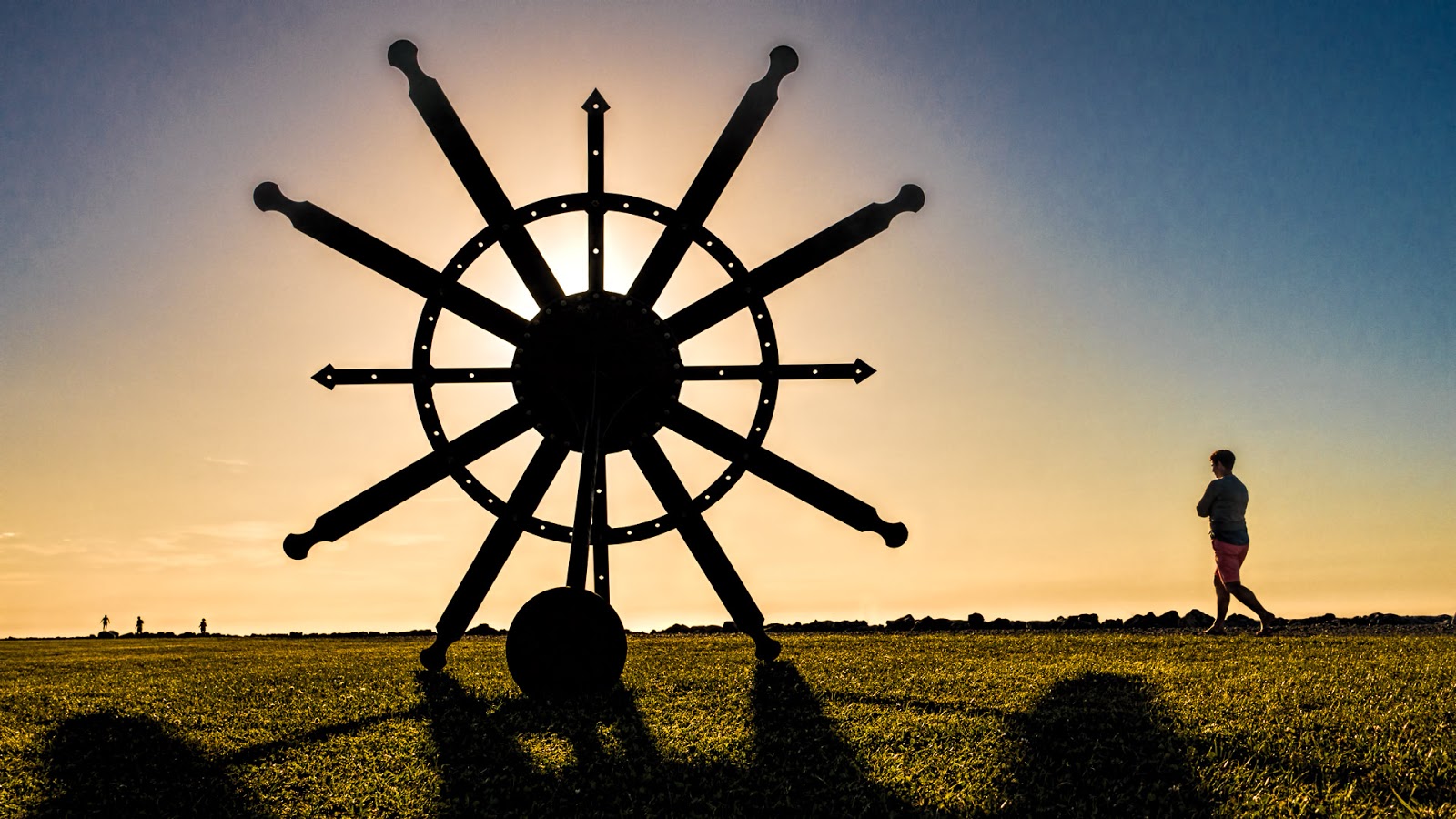
Sunset (nearly) on Hokitika foreshore with one of the art installations.
The only camera I took on this trip was Tillie, the RX100 m3. It was very freeing not having to tote around my DSLR kit and while Tillie's reach at the long end is not enough for wild life shooting, in all other respects she was quite up to the task and produced some wonderful quality files.
The Otira Viaduct from Death's Corner. The old road (behind the ridge to the right) was a driver's nightmare and this corner was well named. Fortunately the viaduct (finished in 1999) cuts out the worst section of the road - a magnificent feat of engineering dwarfed by the landscape.
View over Lake Mahinapua from "Swimmers Beach" - a 2m wide sliver of sand in an otherwise bush edged lake :-).
Swimming from the jetty at at Lake Mahinapua.
The Carnnegie Library at Hokitika - now used as a museum.
The only camera I took on this trip was Tillie, the RX100 m3. It was very freeing not having to tote around my DSLR kit and while Tillie's reach at the long end is not enough for wild life shooting, in all other respects she was quite up to the task and produced some wonderful quality files.
Labels:
Hokitika,
Lake Mahinapua,
Otira Viaduct,
Sony RX100
Location:
Seaview, New Zealand
Tuesday, January 13, 2015
Je Suis Charlie
It didn’t take long - the anti “Je Suis Charlie” brigade are now in full cry with “how can you support such a puerile, offence laden, rag like Charlie Hebdo?”
Who knows how many thousands, probably millions, of people have rallied to the cry of “Je Suis Charlie” in the last few days. Are they all Charlie Hebdo readers? Of course not. Most, in the wider global community, had probably never heard of Charlie Hebdo before last week. Few would probably subscribe to the offensive and frequently vile content of Charlie Hebdo.
“Je Suis Charlie”. It’s hard to make an articulate and comprehensive argument in three words. But one thing is clear, the majority of people were not saying, “I agree with Charlie”. Charlie Hebdo it seems was one of the more disagreeable and unlikeable publications to ever get into print.
But “I am Charlie” in the sense that my participation in a free society, my right to have an opinion and to express it, is based on exactly the same rights as allow Charlie Hebdo to exist - despite what I may think of it. If Charlie Hebdo can not speak, then neither can I - Je Suis Charlie.
As the well known saying goes (usually misattributed to Voltaire) “I disapprove of what you say, but I will defend to the death your right to say it.” - Je Suis Charlie, indeed.
Who knows how many thousands, probably millions, of people have rallied to the cry of “Je Suis Charlie” in the last few days. Are they all Charlie Hebdo readers? Of course not. Most, in the wider global community, had probably never heard of Charlie Hebdo before last week. Few would probably subscribe to the offensive and frequently vile content of Charlie Hebdo.
“Je Suis Charlie”. It’s hard to make an articulate and comprehensive argument in three words. But one thing is clear, the majority of people were not saying, “I agree with Charlie”. Charlie Hebdo it seems was one of the more disagreeable and unlikeable publications to ever get into print.
But “I am Charlie” in the sense that my participation in a free society, my right to have an opinion and to express it, is based on exactly the same rights as allow Charlie Hebdo to exist - despite what I may think of it. If Charlie Hebdo can not speak, then neither can I - Je Suis Charlie.
As the well known saying goes (usually misattributed to Voltaire) “I disapprove of what you say, but I will defend to the death your right to say it.” - Je Suis Charlie, indeed.
Saturday, January 10, 2015
Tillie at the Botanic Gardens
Yesterday, Annette, myself and Tillie went to the Botanic Gardens. It was good to see the conservatory open again (it was closed after the earthquakes in 2011) and to see the new Visitor Centre. This was Tillie’s first real world outing and I was very impressed as to how she handled herself.
The 24mm wide end provides a satisfyingly wide field of view in tight situations allowing this shot of the two-story interior of the main conservatory. While the ambient light shot in a dimly lit exhibit below was no problem, with Tillie deciding that 1/30sec, f2.2 and ISO 125 was the way to go.
Inside the cafeteria Tillie demonstrated her high dynamic range chops by including everything from the brightly lit exterior through to the goodies in the cabinet in a single RAW file, with no fancy post-processing (just Lightroom). Love the ceiling shades and the dappled light they produce - like being under a tree.
On another shot I got Tillie to take 5 bracketed shots for an HDR, which I later merged in Photoshop. However, the results were not as tonally pleasing as the single RAW shot that I also took of the same scene. It would seem that, like the D600, Tillie can manage most high dynamic range shots without any external help.
One of the things I am beginning to appreciate, is Tillie’s ability to get the shot right, it leaves me free to make a grab shot or to concentrate on the aesthetics of the picture and not get distracted by constantly having to worry about camera settings. Of course, if I want a special effect or Tillie isn’t reading the scene correctly then I can intervene with my own settings but why reinvent the wheel every shot?
Why Tillie? Well, there was an English adaptation of “The Little Engine That Could” in which the engine was called Tillie. I think the Sony RX100iii is the ‘little camera that could’, so that’s what I called her.
The 24mm wide end provides a satisfyingly wide field of view in tight situations allowing this shot of the two-story interior of the main conservatory. While the ambient light shot in a dimly lit exhibit below was no problem, with Tillie deciding that 1/30sec, f2.2 and ISO 125 was the way to go.
Inside the cafeteria Tillie demonstrated her high dynamic range chops by including everything from the brightly lit exterior through to the goodies in the cabinet in a single RAW file, with no fancy post-processing (just Lightroom). Love the ceiling shades and the dappled light they produce - like being under a tree.
On another shot I got Tillie to take 5 bracketed shots for an HDR, which I later merged in Photoshop. However, the results were not as tonally pleasing as the single RAW shot that I also took of the same scene. It would seem that, like the D600, Tillie can manage most high dynamic range shots without any external help.
One of the things I am beginning to appreciate, is Tillie’s ability to get the shot right, it leaves me free to make a grab shot or to concentrate on the aesthetics of the picture and not get distracted by constantly having to worry about camera settings. Of course, if I want a special effect or Tillie isn’t reading the scene correctly then I can intervene with my own settings but why reinvent the wheel every shot?
Why Tillie? Well, there was an English adaptation of “The Little Engine That Could” in which the engine was called Tillie. I think the Sony RX100iii is the ‘little camera that could’, so that’s what I called her.
Thursday, January 1, 2015
The Last Camera
The last camera I brought was not a rip-roaring success. It was a Panasonic LF1 - I wanted it as a go anywhere accompaniment to my full-frame DSLR. It seemed to tick the right boxes (very small, RAW shooter, EVF) and the reviews were quite good too. But, in use, it never met my expectations for image quality.
Of course I knew that the LF1 wouldn’t produce full-frame quality (or even close) but I soon found that the RAW files just seemed to lack spunk. Whenever I went to develop one, it felt like I was having to give it CPR with Lightroom, just to get it looking average. It wasn’t just the sensor noise (evident even at the lowest ISO) but a general flatness and lack of detail that no reasonable amount of sharpening or clarity seemed able to overcome.
I don’t think I ever had a frame out of that camera that made me whoop for joy. In the end I just didn’t want to pick it up - it was like having a friend who always turned up at your house feeling miserable; guaranteed to lower the spirit of any occasion. Who needs a camera like that? The LF1 did, however, prove that a camera of this size is a useful thing to have - if only it could produce better images! So my search continued for a compact camera that I would be happy to use when not toting a DSLR. And I am now confident that I have found it.
In the last couple of days, I have processed well over a hundred RAW files from this compact and I am in awe of its capabilities in both general, low light and high dynamic range situations. Perhaps that is why all the reviews unanimously rate it as the very best camera in its class. It’s also almost the same size as the LF1 (just a little thicker).
So, after weeks of research and waiting for the mail man, my Sony RX100 iii is now firmly in my hot little hands (thank you wifey)- this one could be the elusive Last Camera for this aging photographer. Play time!
Taken with the Sony RX100 iii, 1/125sec, f4.0, ISO 125 - RAW file processed in Lightroom.
Of course I knew that the LF1 wouldn’t produce full-frame quality (or even close) but I soon found that the RAW files just seemed to lack spunk. Whenever I went to develop one, it felt like I was having to give it CPR with Lightroom, just to get it looking average. It wasn’t just the sensor noise (evident even at the lowest ISO) but a general flatness and lack of detail that no reasonable amount of sharpening or clarity seemed able to overcome.
I don’t think I ever had a frame out of that camera that made me whoop for joy. In the end I just didn’t want to pick it up - it was like having a friend who always turned up at your house feeling miserable; guaranteed to lower the spirit of any occasion. Who needs a camera like that? The LF1 did, however, prove that a camera of this size is a useful thing to have - if only it could produce better images! So my search continued for a compact camera that I would be happy to use when not toting a DSLR. And I am now confident that I have found it.
In the last couple of days, I have processed well over a hundred RAW files from this compact and I am in awe of its capabilities in both general, low light and high dynamic range situations. Perhaps that is why all the reviews unanimously rate it as the very best camera in its class. It’s also almost the same size as the LF1 (just a little thicker).
So, after weeks of research and waiting for the mail man, my Sony RX100 iii is now firmly in my hot little hands (thank you wifey)- this one could be the elusive Last Camera for this aging photographer. Play time!
Taken with the Sony RX100 iii, 1/125sec, f4.0, ISO 125 - RAW file processed in Lightroom.
Labels:
camera,
compact,
Oxford,
RAW,
Sony RX100
Location:
Oxford, New Zealand
Monday, December 29, 2014
A short stroll in Infrared
Now that it's post Christmas, we are in stay at home mode until the road madness subsides. This morning it was a short stroll down town before the temperature rises too much. I find it hard to photograph my own stomping ground; everything is so familiar. So, this morning, I took the infrared camera in the hope that a different wavelength might provide some inspiration. Nothing awe inspiring here, just a rather different type of holiday snap.
On our street - white leaves against dark sky
My favourite cafe
Pearson Park looking toward Mt Oxford
Memorial - Pearson Park
Path in Pearson Park - looks like snow (it isn't)
Maggie Pie taking flight
Across the cricket field to Mt Oxford
Looking East from Pearson Park
I like the way that foliage fluoresces almost white with infrared, while clear sky is almost devoid of IR and turns nearly black. The middle of a sunny day isn't the best time for ordinary photography but it is a great time for IR.
Location:
Oxford, New Zealand
Monday, December 1, 2014
Scanbot
Usually I download an app to my phone, only to find a few weeks later that I never use it and it ends up being deleted. Some apps like Feedly wheedle themselves into your daily life. But rarely does an app become more and more useful as time goes on. Such an app is Scanbot.
For the last couple of years I have been going paperless, scanning most documents I receive on a flat-bed scanner and dumping the paper. It’s worth it to save collecting boxes of receipts, warranties and bills but it’s a tedious process, especially if I let the paperwork back up for a few weeks.
Then I found Scanbot - Android (free), iOS (paid). Here’s the deal; put your document on a flat surface, hold your phone over the document, pause and the document is ‘scanned’ - actually photographed, squared off, trimmed and saved as a PDF. Multi-page documents are no problem and get combined into a multi-page PDF. Super easy and I can scan documents as they arrive and immediately bin the paper. Scanned documents are automatically uploaded to my Dropbox account (other cloud services are supported).
Then I found another use. Turning the hundreds of old family photos into digital. My digital photo library started in 2001. Before that it is folders of printed photos collected over a few decades of camera toting family life. I didn’t have very high hopes but scanbot, combined with my phone’s 13Mp camera, does a wonderful job of turning the prints into reasonable digital images. Colours are true and, while you can’t make a silk purse out of a sow’s ear, a few tweaks in Lightroom can often improve on the quality of original print.
The results are perfectly usable for online use and for reprinting at the original size. I probably wouldn’t print larger, but this was from a wallet sized print taken in 1982:

For the last couple of years I have been going paperless, scanning most documents I receive on a flat-bed scanner and dumping the paper. It’s worth it to save collecting boxes of receipts, warranties and bills but it’s a tedious process, especially if I let the paperwork back up for a few weeks.
Then I found Scanbot - Android (free), iOS (paid). Here’s the deal; put your document on a flat surface, hold your phone over the document, pause and the document is ‘scanned’ - actually photographed, squared off, trimmed and saved as a PDF. Multi-page documents are no problem and get combined into a multi-page PDF. Super easy and I can scan documents as they arrive and immediately bin the paper. Scanned documents are automatically uploaded to my Dropbox account (other cloud services are supported).
Then I found another use. Turning the hundreds of old family photos into digital. My digital photo library started in 2001. Before that it is folders of printed photos collected over a few decades of camera toting family life. I didn’t have very high hopes but scanbot, combined with my phone’s 13Mp camera, does a wonderful job of turning the prints into reasonable digital images. Colours are true and, while you can’t make a silk purse out of a sow’s ear, a few tweaks in Lightroom can often improve on the quality of original print.
The results are perfectly usable for online use and for reprinting at the original size. I probably wouldn’t print larger, but this was from a wallet sized print taken in 1982:

Monday, October 13, 2014
Keeping it simple
Today we did 'simple' - as in taking delight in small blessings; like a drive to New Brighton, lunch at the pier and a short walk on the beach with my lady. There is a certain purity about a spring day, a soft salty breeze and the sound of surf gently breaking on the beach, that erases (temporarily, anyway) the weightier and more intractable obstacles to life. After that we put the car through a car-wash, so we all came home feeling a little fresher than when we set out.
Subscribe to:
Posts (Atom)